
Hirain on the Future of Camera Monitor Systems and AR-HUD
Explore how Hirain is advancing Camera Monitor Systems, 3D AR-HUD and intelligent cockpit technology with AI, optics and low-latency processing.
InCabin Europe 2026: 3 Takeaways Shaping the Future Cabin

InCabin Europe 2026 brought together the people shaping what happens inside the vehicle – from driver and occupant monitoring to HMI, audio, comfort and wellbeing. Co-located with AutoSens in Barcelona from 22 to 24 September, it showed an industry thinking well beyond compliance.
What Comes Next for DMS+OMS: A Conversation with Tobii

We spoke to Carmen Pătrașcu, who leads Tobii’s interior sensing Sales and Marketing, about what comes after the world’s first single-camera DMS+OMS solution reaches the road, and how broader adoption can open the next chapter of interior sensing.
As Head of Sales and Marketing, Carmen works where Autosense technology meets the market. Her focus is not only on turning complex engineering into a clear proposition, but also on understanding what different OEMs and Tier 1s need to move from interest to implementation.
Safety-Certified In-Cabin Architectures: From Concept to ISO 26262 Evidence

As in-cabin systems become more sophisticated, demonstrating functional safety is no longer just about meeting compliance requirements.
Modern software-defined vehicle architectures demand safety to be built into the platform from the very beginning, with careful attention to partitioning, isolation, verification and traceability. In this interview, Ofra Bechor, Regional Field Application Engineer at Green Hills Software, explains the architectural principles behind safety-certified in-cabin systems, the realities of ISO 26262 assessment, and how development teams can reduce certification effort while building scalable, future-ready platforms.
Beyond Child Presence Detection: The Rise of Multistatic UWB in the Intelligent Cabin

Ultra-wideband (UWB) technology is evolving rapidly from a secure digital key solution into one of the automotive industry’s most promising sensing technologies.
By enabling accurate occupant detection, vital-sign monitoring and child presence detection without relying on cameras, multistatic UWB offers a privacy-preserving approach to in-cabin intelligence. We spoke with Yaohui Liu, EMEA FAE & Marketing Manager at Calterah, about how synchronized multistatic UWB is improving resolution and reliability, the role of the emerging IEEE 802.15.4ab standard, and the technical and regulatory challenges that still stand between today’s prototypes and large-scale automotive deployment.
Beyond Weight Sensors: How Tactile Sensing Could Transform Occupant Classification
As vehicle restraint systems become more intelligent, accurately understanding who is sitting in each seat and how they are positioned is becoming just as important as detecting that someone is there.
Existing occupancy sensing technologies, including weight sensors, cameras and radar, each have limitations when it comes to reliably classifying occupants across different body types and seating scenarios. We spoke with Christine Fraser, Co-Founder & COO of Brighter Signals, about how tactile sensing could provide a new layer of occupant intelligence, improve classification accuracy for vulnerable passengers, and help enable safer, more personalised restraint systems.
Why Global Shutter HDR Is the Next Step for In-Cabin Cameras
As in-cabin cameras take on more responsibilities, from driver monitoring and occupant sensing to videoconferencing and user authentication, image sensors must deliver far more than high-quality pictures.
The rise of RGB-IR imaging is driving demand for High Dynamic Range (HDR) capabilities that work with global shutter technology, enabling reliable sensing in challenging lighting conditions. We spoke with Tomas Geurts, Senior R&D Director, Europe at OMNIVISION, about why HDR requirements are changing, how RGB-IR is reshaping in-cabin monitoring, and what future camera architectures will need to support the next generation of intelligent vehicle interiors.
Beyond Compliance: How Agentic AI Could Unlock the Next Generation of Occupant Monitoring
Occupant Monitoring Systems (OMS) are evolving from regulatory necessities into intelligent platforms capable of understanding occupants, context and intent.
As legal requirements and Euro NCAP establish the baseline for safety, the next wave of innovation lies in using the same sensing infrastructure to enable proactive safety, personalised assistance, comfort and more natural human-vehicle interaction. We spoke with Dr. Frederik Diederichs, Head of Perceptual User Interfaces Group at Fraunhofer IOSB, about how agentic AI, multimodal sensing and rapid prototyping tools such as AktiMeter are helping the industry explore what comes next for intelligent in-cabin systems.
An Interview with Naresh Ravuri: New Advisory Board Member

InCabin is excited to welcome Naresh Ravuri, Senior Engineering Manager at Magna Electronics, to its esteemed Advisory Board.
Behind the Scenes at Seeing Machines: A Vision for Safer Roads
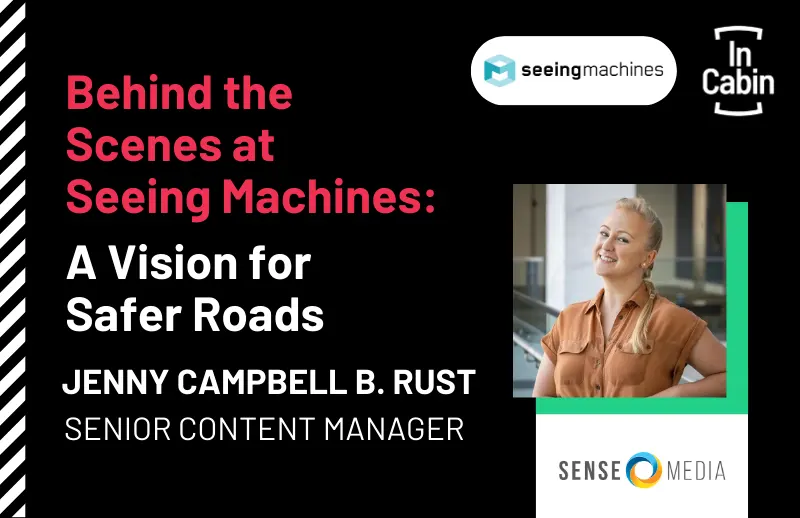
Jenny Campbell B. Rust, our Senior Content Manager, visited the Seeing Machines headquarters in Canberra for an exclusive behind-the-scenes look at their cutting-edge driver and occupant monitoring technology.