
InCabin Europe 2026: 3 Takeaways Shaping the Future Cabin

InCabin Europe 2026 brought together the people shaping what happens inside the vehicle – from driver and occupant monitoring to HMI, audio, comfort and wellbeing. Co-located with AutoSens in Barcelona from 22 to 24 September, it showed an industry thinking well beyond compliance.
InCabin Europe 2026 – Press Conference Recap
Read more about the latest automotive interior sensing developments announced at InCabin Europe 2026.
What Comes Next for DMS+OMS: A Conversation with Tobii

We spoke to Carmen Pătrașcu, who leads Tobii’s interior sensing Sales and Marketing, about what comes after the world’s first single-camera DMS+OMS solution reaches the road, and how broader adoption can open the next chapter of interior sensing.
As Head of Sales and Marketing, Carmen works where Autosense technology meets the market. Her focus is not only on turning complex engineering into a clear proposition, but also on understanding what different OEMs and Tier 1s need to move from interest to implementation.
How Multimodal Sensing Is Transforming Occupant Monitoring

Understanding the occupant is moving beyond traditional camera-based monitoring.
Radar, physiological sensing, audio and vision can work together to build a richer picture of a person’s physical, cognitive and emotional state, opening new possibilities for safety, wellbeing and personalisation. Diego Val, Head of Research Programs – New Solutions & Technologies in the Innovation Department at and Iñigo Mateo, Corporate Innovation Directorate at Antolin, discuss how multimodal sensing and sensor fusion could enable more robust occupant monitoring, and the challenges of integrating these technologies seamlessly into the vehicle interior.
How Hand-Tracking Is Shaping the Future of In-Cabin Monitoring
From detecting distraction to predicting driver intent, hand-tracking is becoming an increasingly valuable part of the intelligent cockpit.
As in-cabin monitoring evolves beyond traditional gaze and facial analysis, advances in computer vision are unlocking new ways to understand driver behaviour and create safer, more intuitive human-machine interfaces. In this interview, Agnes Jernström, Senior Software Engineer at Neonode, explains how hand-tracking is helping to advance occupant monitoring and the next generation of in-cabin AI.
Beyond Cameras: The Future of Ultrasonic In-Cabin Sensing
Discover how Onsemi’s ultrasonic sensing enhances in-cabin monitoring with privacy, edge processing and advanced occupant detection.
Beyond Child Presence Detection: The Rise of Multistatic UWB in the Intelligent Cabin

Ultra-wideband (UWB) technology is evolving rapidly from a secure digital key solution into one of the automotive industry’s most promising sensing technologies.
By enabling accurate occupant detection, vital-sign monitoring and child presence detection without relying on cameras, multistatic UWB offers a privacy-preserving approach to in-cabin intelligence. We spoke with Yaohui Liu, EMEA FAE & Marketing Manager at Calterah, about how synchronized multistatic UWB is improving resolution and reliability, the role of the emerging IEEE 802.15.4ab standard, and the technical and regulatory challenges that still stand between today’s prototypes and large-scale automotive deployment.
Beyond Weight Sensors: How Tactile Sensing Could Transform Occupant Classification
As vehicle restraint systems become more intelligent, accurately understanding who is sitting in each seat and how they are positioned is becoming just as important as detecting that someone is there.
Existing occupancy sensing technologies, including weight sensors, cameras and radar, each have limitations when it comes to reliably classifying occupants across different body types and seating scenarios. We spoke with Christine Fraser, Co-Founder & COO of Brighter Signals, about how tactile sensing could provide a new layer of occupant intelligence, improve classification accuracy for vulnerable passengers, and help enable safer, more personalised restraint systems.
Seeing Machines to Showcase Rare Live Demo at InCabin Europe 2025

Driver inattention remains one of the toughest safety challenges in automotive. With Euro NCAP’s 2030 protocols set to include cognitive distraction, the industry is being pushed beyond visual detection into broader inattention management. Seeing Machines is leading that shift — and for the first time in years, they’ll showcase their technology live at InCabin Europe 2025. Read the full blog below.
Behind the Scenes at Seeing Machines: A Vision for Safer Roads
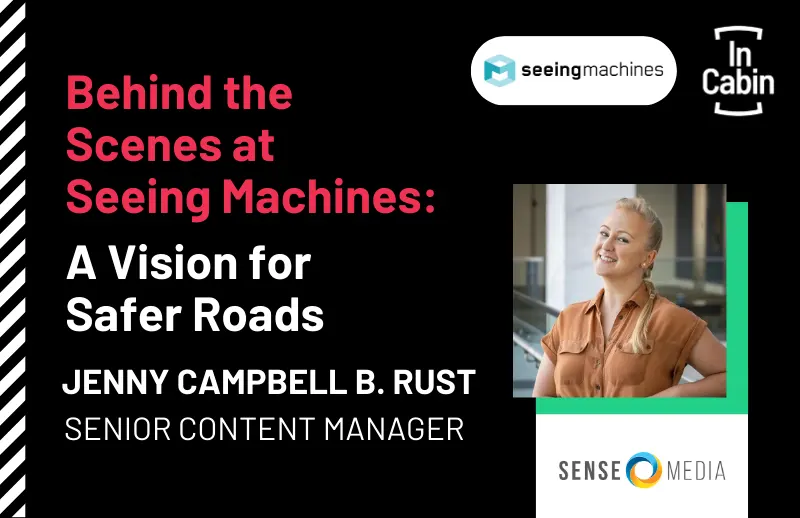
Jenny Campbell B. Rust, our Senior Content Manager, visited the Seeing Machines headquarters in Canberra for an exclusive behind-the-scenes look at their cutting-edge driver and occupant monitoring technology.