
InCabin Europe 2026: 3 Takeaways Shaping the Future Cabin

InCabin Europe 2026 brought together the people shaping what happens inside the vehicle – from driver and occupant monitoring to HMI, audio, comfort and wellbeing. Co-located with AutoSens in Barcelona from 22 to 24 September, it showed an industry thinking well beyond compliance.
What Comes Next for DMS+OMS: A Conversation with Tobii

We spoke to Carmen Pătrașcu, who leads Tobii’s interior sensing Sales and Marketing, about what comes after the world’s first single-camera DMS+OMS solution reaches the road, and how broader adoption can open the next chapter of interior sensing.
As Head of Sales and Marketing, Carmen works where Autosense technology meets the market. Her focus is not only on turning complex engineering into a clear proposition, but also on understanding what different OEMs and Tier 1s need to move from interest to implementation.
How Multimodal Sensing Is Transforming Occupant Monitoring

Understanding the occupant is moving beyond traditional camera-based monitoring.
Radar, physiological sensing, audio and vision can work together to build a richer picture of a person’s physical, cognitive and emotional state, opening new possibilities for safety, wellbeing and personalisation. Diego Val, Head of Research Programs – New Solutions & Technologies in the Innovation Department at and Iñigo Mateo, Corporate Innovation Directorate at Antolin, discuss how multimodal sensing and sensor fusion could enable more robust occupant monitoring, and the challenges of integrating these technologies seamlessly into the vehicle interior.
The Future of Automotive Interiors Through a Global UX Lens

Electrification, software-defined vehicles, artificial intelligence, and evolving regulations are reshaping not only how vehicles are engineered, but also how customers experience them.
At the same time, consumer expectations are becoming increasingly regional. Markets such as Europe, North America, and China are evolving at different speeds and often prioritise different aspects of the mobility experience. For designers, understanding these cultural, technological, and behavioural differences is becoming just as important as keeping pace with the latest innovations. Against this backdrop, here are my thoughts on four key topics shaping the future of automotive interiors.
Synthetic Data for In-Cabin Monitoring and Virtual Validation

As in-cabin monitoring systems become more sophisticated, validating DMS, OMS and child presence detection across real-world human behaviour, sensor conditions and edge cases is becoming increasingly difficult.
Javier Salado, Product Manager at Anyverse, explains how synthetic data and simulation can support in-cabin monitoring validation, reduce the domain gap between virtual and real sensor data, and contribute to future Euro NCAP virtual assessment ahead of InCabin Europe 2026.
Iris Recognition Comes to the Cabin: Low-Resolution Breakthroughs and Multimodal Fusion
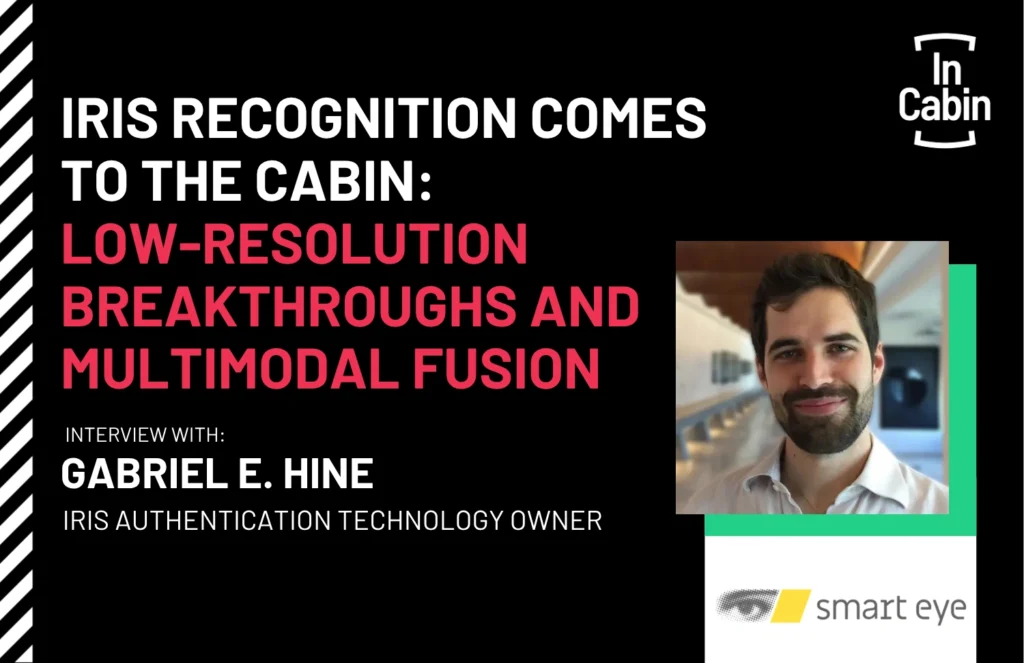
Iris recognition has long been one of the most accurate ways to confirm who a person is. Yet for decades, it stayed locked inside smartphones, border-control gates, and dedicated access terminals.
Ahead of his session at InCabin Europe, Gabriel Hine, an Iris Authentication Technology Owner at Smart Eye explains how his team moved iris recognition out of those controlled settings and into the vehicle cabin, why combining iris with face recognition beats either one alone, and what this unlocks for the car once identity can be established from cameras the vehicle already carries.
Leading OEMs and Tier 1s Are Coming to InCabin Europe
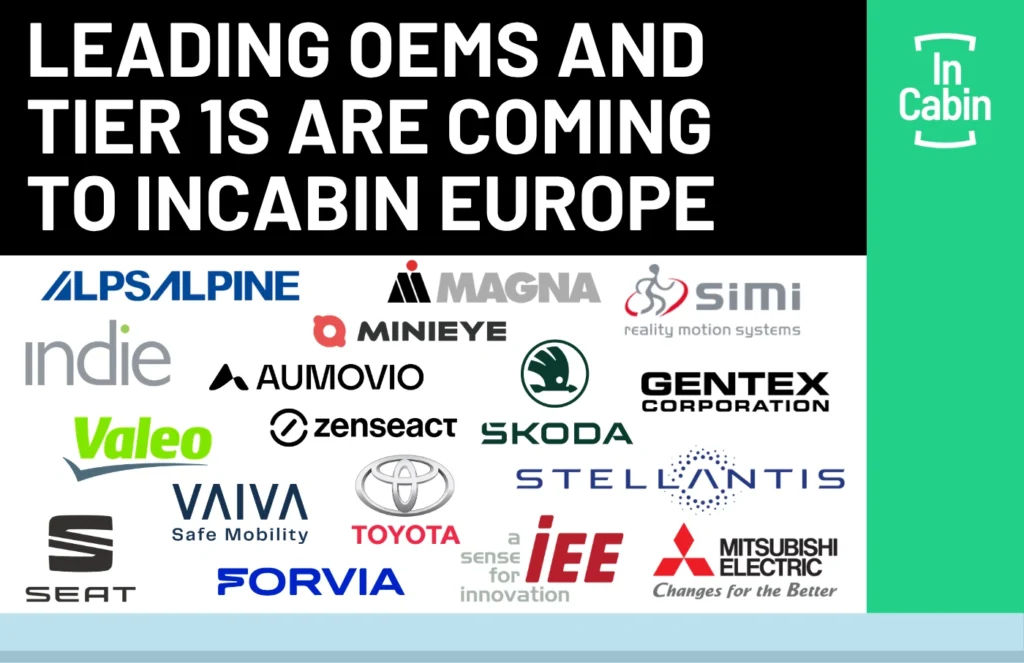
InCabin Europe brings together experts from across the automotive supply chain, creating a focused meeting point for the in-cabin engineering community.
With 60% of attendees coming from OEMs and Tier 1s, you’ll be in the room with engineers, technical leaders and decision makers from companies already confirmed, including Toyota, Stellantis, Škoda, SEAT, Magna, Valeo, Mitsubishi Electric and more…
Safety-Certified In-Cabin Architectures: From Concept to ISO 26262 Evidence

As in-cabin systems become more sophisticated, demonstrating functional safety is no longer just about meeting compliance requirements.
Modern software-defined vehicle architectures demand safety to be built into the platform from the very beginning, with careful attention to partitioning, isolation, verification and traceability. In this interview, Ofra Bechor, Regional Field Application Engineer at Green Hills Software, explains the architectural principles behind safety-certified in-cabin systems, the realities of ISO 26262 assessment, and how development teams can reduce certification effort while building scalable, future-ready platforms.
How Hand-Tracking Is Shaping the Future of In-Cabin Monitoring

From detecting distraction to predicting driver intent, hand-tracking is becoming an increasingly valuable part of the intelligent cockpit.
As in-cabin monitoring evolves beyond traditional gaze and facial analysis, advances in computer vision are unlocking new ways to understand driver behaviour and create safer, more intuitive human-machine interfaces. In this interview, Agnes Jernström, Senior Software Engineer at Neonode, explains how hand-tracking is helping to advance occupant monitoring and the next generation of in-cabin AI.
The Shift to Centralized Radar Processing for Software-Defined Vehicles

Modern vehicles are rapidly becoming software-defined, and with that shift comes a new expectation for perception: higher fidelity sensing, lower latency decision-making, and a platform that can scale across trim levels and regulatory regions without reinventing the hardware each time. Radar sits at the center of this evolution because it delivers robust perception in conditions where other sensors can degrade- fog, rain, snow, spray, and low light- making it a foundational technology for next-generation ADAS and automated driving stacks.