Is this report for you? Yes if:
- You attended AES: then look for yourself in the content, and see content you didn’t get a chance to see or hear
- You didn’t attend AES: then see updates and debates that you missed from a few presentations and demos
…that should cover everyone shouldn’t it?
- If you ARE an ‘audio person’ this will have updates on suggested solutions to recent industry challenges and a good way to snoop the other industry players
- If you are a DMS/cockpit and/or ARE NOT an ‘audio person’ this will introduce you to some new terms so you can sound cool and smart when you meet these audio people at InCabin
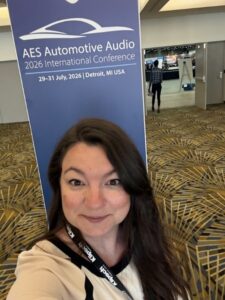
This was my first ever automotive audio event! A big thank you to AES, the Audio Engineering Society, for having me as a guest! I found the event very informative and friendly.
Speaking of friendly, I made friends with someone who is a tuning engineer for an OEM and she kindly allowed me to tag along as she did demos, and explained what they are listening for, and taught me tons of terminology. I wouldn’t have learned or experienced nearly as much without a personal guide, I am so grateful to her!
So, what are tuning engineers listening for and how do we do it too?
- Staging or the sound stage, meaning that the vocalist should sound like they are in the center and the instruments should sound as if they are positioned according to how they would be on a stage. I asked someone “when you say in the middle do you mean that they should sound like they’re in the middle to me as the driver, that each user should experience the singer in the middle of where they are, or does it mean that the singer should sound like they’re in the middle of the car” They got that funny look on their face and explained that that is a matter of opinion, and they don’t have an answer.
- They are listening to certain songs for sounds they are used to hearing in that particular song, for instance, Royals by Lourde, we’re listening for the snaps, it should sound like a real snap to us, in Hotel California we’re listening for the particular instruments, Sail for the great bass, Norah Jones for a smokey, close voice. They listen for the right sharpness, loudness, roughness, tonality, warmth etc.
- They’re listening for bad sounds like BSR, buzz, squeak, rattle, often from the bass in the door, where other door components haven’t been installed snugly enough. They are listening for crackling, for dullness, distortion, echo, double talk, etc.
- When we listen, we will listen to 1 part of the song, a 15-30 second clip. Then we switch the listening mode and listen to the same part again. We repeat that on all the different sound systems once or twice then we move to the next song and do it again. In the real world they will listen in a perfect-ish listening environment or sound room, and then go listen to the same sound in the car.
- One thing was so weird each time that I finally asked a listener “you sit so still, wouldn’t it be more realistic if you bopped your head like the users will?” …apparently, we need to sit still to do the first few rounds of listening but later, once we know we like it, we can do more head bopping. I found head bopping a little too irresistible.
Audio and Speaker Basics
If you like Physics, Trig, or Signals & Systems you’ll find plenty of familiar concepts to get stuck in to in audio! Sound is just waves and this whole event is about managing those waves, which reflect and bounce all around the cabin. The speakers need to push air and create vibrations. When we can hear those vibrations, they are sound. When we can feel vibrations, like through our seat, they are called haptics.
We have tweeters which are the high frequencies, mids, aptly named, and subwoofers (or ‘subs’) which is what bass – or deep vibration – comes from. Low frequencies move more air, so that’s why your subs are big.
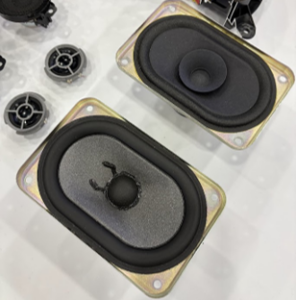
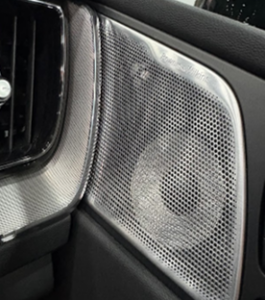
There are different materials for this cone part, in the photo below these are both paper – which is good because it’s light weight, the other is a treated paper. Plastic is also a popular choice, and this one looked like metal from Bowers & Wilkins in the Aptiv car.
This speaker shape pictured is nicknamed racetrack and these are mids. The tiny circles you can see are tweeters.
When you go to the car demos to listen, they have multiple modes set up with different speaker or software configurations, many with and without Dolby Atmos – I will get into that in Part 2 (coming soon). At Pioneer they had 3 different sound system options for us to listen to:
- 10 SPK Stereo
- 13 SPK Premium Stereo without Sub
- 14 SPK Premium Stereo with Sub
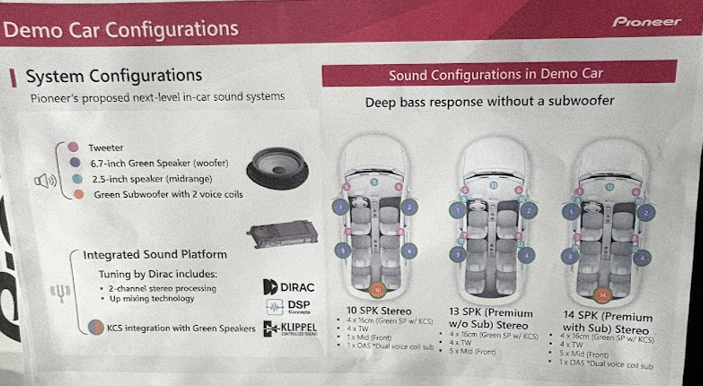
The things to notice here are that the 2nd system doesn’t have a sub in the back, and the first system is missing the mids on the side of the car, meaning that the center mid on the dashboard has to do more to make up for those. A Green Speaker or Subwoofer means it is lighter weight and therefore ‘green’.
Challenges for Automotive Audio
Good society events help the industry solve challenges, here are just a few of the challenges being raised and worked on as of August 2026.
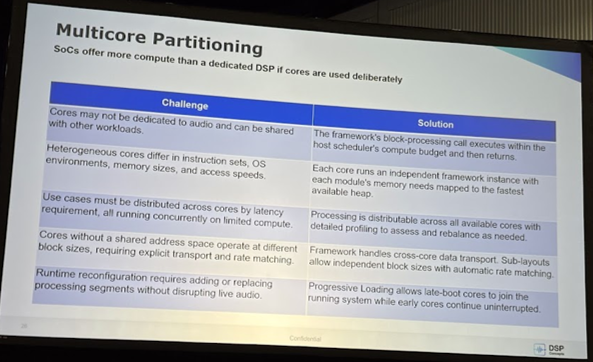
From DSP Concepts:
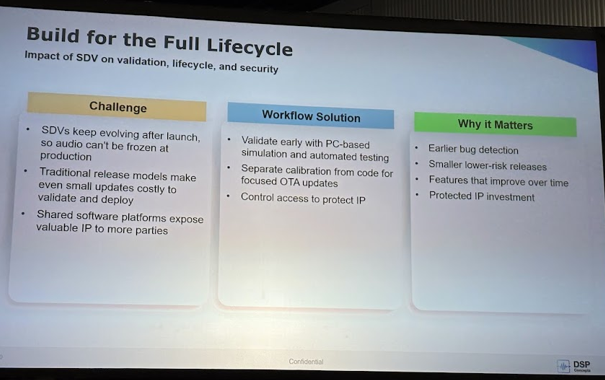
SDV adoption means that audio needs to be updatable which can be costly and shared SW platforms expose IP to more parties.
Low latency is required for basic audio applications like noise cancellation, where the external microphone picks up the soundwave from the roadway and inside an exact inverse is produced in real time to cancel out the soundwave of the road noise.
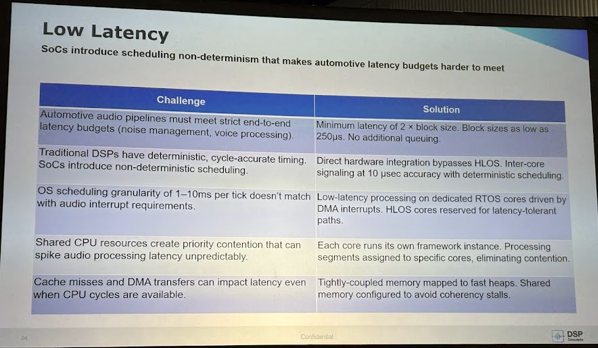
How do we move these signals around the car with varying cores and architectures?
From testing companies:
Engineers responsible for responding to tuning feedback from listeners/tuning engineers are interested in having measurable metrics and KPIs to tune to. They are building new software and ways to test, more on this in Part 2.
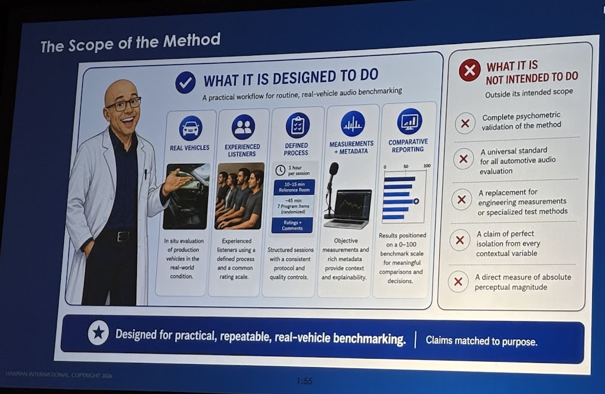
From Harman Automotive:
Challenges for Listeners (sound quality testers) during the tuning process,
- Hard to control, repeat, and correlate with metrics
- High cost and slow
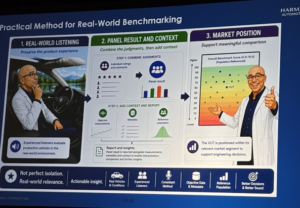
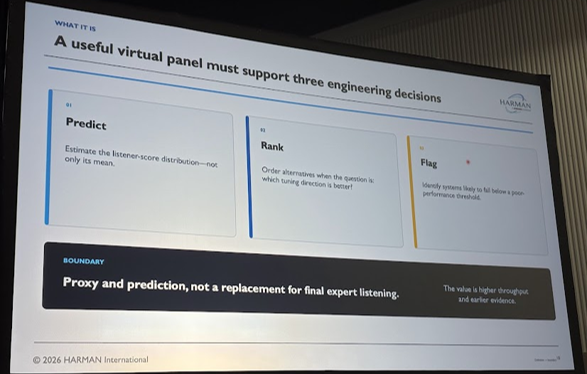
Harman suggests collecting particular data, creating insights, and adding it in along with the panel’s (human listeners) judgments.
Smart Audio Innovations
While we’re talking about Harman, Andrey Filimonov presented on Virtual Panels, where you would use an ML trained panel of listeners, or ‘virtual panel’, for human listeners to bounce ideas off of, not to replace them. It sounded like an obstacle was number of audio systems for training an ML network, they had 940 systems at the time of their training. My next step is to ask the tuning engineers for their reaction to this idea.
What to know about amps? There are amps and smart amps. Simply put, Pioneer showed smart amps and they have the processing onboard. Pictured below these are both smart amps with large heat syncs on them to keep them cool. They don’t use fans to cool them because fans make noise, I held these and they are very heavy.
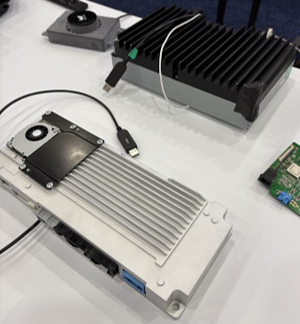
Alternatively, some OEMs are demanding non-smart amps which I have nicknamed “Commodity amps” instead of their meaner industry nickname. It sounds like US OEMs want the option of the modular system because it is the smart components where they can make up cost. So if they choose a modular system rather than a smart amp with it all in one, they have more control of what they’re spending on.
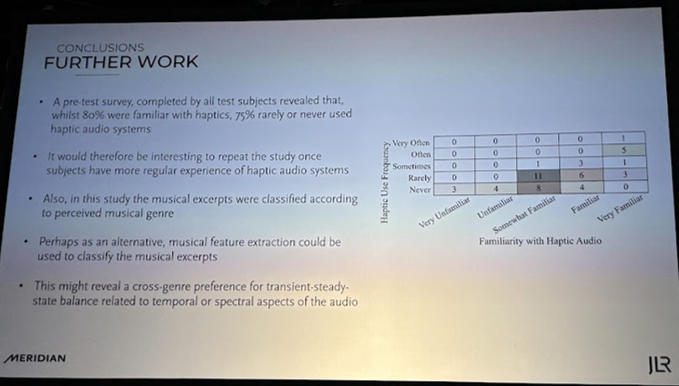
Meridian (and JLR) presented on an in-seat audio tactile system, which is using tactile vibrations to enhance the sound experience; this is done using haptics transducers. This was an interesting presentation, and especially relevant to our seat partners at InCabin, so I’m sharing a few slides here. To be candid, this was a little beyond my understanding, but I understood the basic ideas explained, and thought it seemed interesting enough to share.
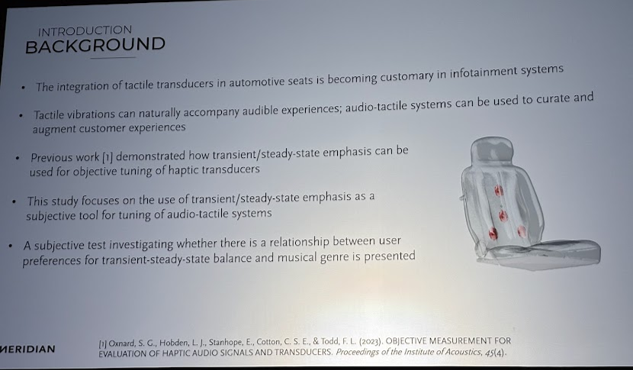
They explained that these haptic transducers or tactile transducers are common now for infotainment and that they conducted a study to see if there was a relationship between [technical audio elements above my head], and the genre of music.
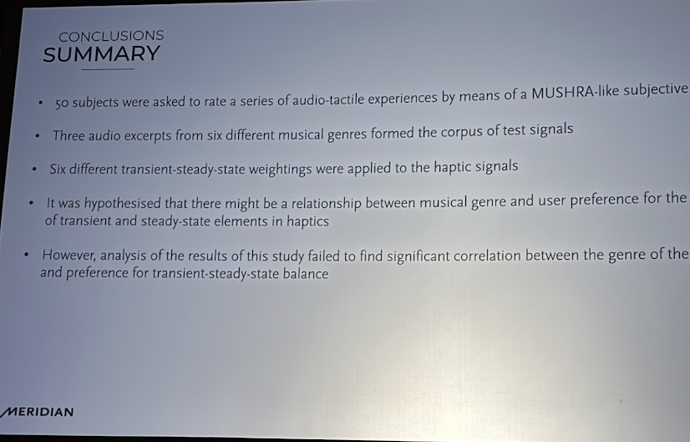
The study was found to be inconclusive, but recommended to repeat with users who are more familiar with seat haptics. In the third slide you can see the frequency or familiarity with seat haptics by their test subjects, and I found it to be very low. I agree that it would be better to conduct this test with users who are more familiar with the general haptics experience.
Return for Part 2 which will have a company directory going into more detail about each company that was there and what they showed, driving demo review, as well as a very handy glossary and further industry updates!
I really enjoyed the event’s feeling of a reunion for all these innovators to check out what each other were working on together in Detroit! There were people from all over the world, fantastic drinks receptions, and very technical paper presentations. If you’re continuing the fun and momentum, and coming to InCabin Barcelona at the end of September, you can use code AESAUTOEUROPE for 20% off your pass.
If you want to speak at InCabin in Detroit in May, you can submit 500 words to apply now here
Add your company’s logo to the In-cabin Market Map here
Part 2 Coming Soon!


Interested in exterior vehicle sensing technology?
With a pass to InCabin Europe, you’ll also get full access to our
co-located sister event, AutoSens. Find out more here >>