
Written by:

As vehicles become more human-centred environments, the way we interact with them is evolving beyond screens and touchpoints.
At InCabin USA 2026, Syntiant will showcase a live demo exploring how audio can extend interaction beyond the cabin, enabling vehicles to respond to the world around them as well as the occupants inside.
In this preview, they outline why exterior audio sensing has remained a technical challenge, and how a new approach – combining novel sensing hardware with on-device AI – enables reliable detection of meaningful acoustic events, from emergency sirens to spoken commands, in real-world automotive conditions. Find out more below…
Modern vehicles are getting better at seeing the world. Cameras, radar and LiDAR have advanced rapidly over the past decade. But when it comes to hearing, especially outside the vehicle, progress has been much slower.
That’s not because audio isn’t important. It’s because it’s hard.
Capturing sound outside a moving vehicle is fundamentally different from capturing sound inside the cabin.
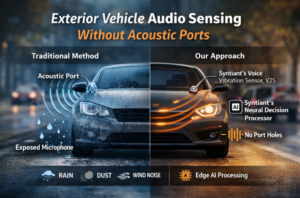
At highway speeds, wind noise becomes dominant. Add rain, dust and road noise, and the signal you care about, whether it’s a siren or a spoken command, can easily get lost. Traditional microphone systems also require acoustic port holes, which expose sensitive components to the environment and create long-term reliability challenges.
For automotive applications, that combination of high noise and harsh exposure has made exterior audio sensing difficult to deploy at scale.
At InCabin this year, we’re showcasing a new approach to exterior audio sensing that removes one of the biggest challenges: collecting sound through an exposed acoustic port in extreme environments.
Our Syntiant Voice Vibration Sensor (V2S) captures acoustic activity from anywhere on the vehicle body without any exposed openings. This allows the sensing element to remain protected from water, dust, and environmental stress, while still detecting meaningful external signals.
Learn more: https://www.syntiant.com/automotive-v2s
The data is then processed directly on Syntiant’s Neural Decision Processor, which connects to the sensor and runs inference locally. This enables continuous, always-on detection of acoustic events without needing to stream data to the cloud.
More on the hardware: https://www.syntiant.com/hardware
To make the system practical and deployable, we also provide optimized CNN models trained to detect and classify key audio events such as emergency vehicle sirens and external voice commands.
Together, this creates a complete system:
Sensor → On-device processing → Real-time classification
This technology enables a capability that has been difficult to achieve reliably until now: practical, deployable exterior audio sensing. Our live demo focuses on two key capabilities:
This technology enables a capability that has been difficult to achieve reliably until now: practical, deployable exterior audio sensing. Our live demo focuses on two key capabilities:
- Siren Detection in Real-World Conditions
The system can detect the presence of emergency vehicles andidentify their acoustic signature, even in noisy environments. This is increasingly important as regulatory requirements evolve for autonomous and advanced driver assistance systems. - External Voice Command Recognition
We alsodemonstrate the ability to detect spoken commands from outside the vehicle such as “open trunk” or “unlock.” This allows more natural interaction with the vehicle without relying on physical interfaces or proximity-based sensors.
Beyond interaction and safety, exterior audio sensing unlocks additional functionality. For example, theft detection becomes possible by identifying events like glass breaking. Because the system operates in an ultra-low-power, always-on mode, the sensor, processor, and model can remain active even when the vehicle is off, enabling continuous monitoring without impacting battery life.
As vehicles become more automated, they need to do more than just see their environment, they need to understand it. Audio provides a layer of context that other sensors can’t capture. A siren behind a vehicle, a verbal instruction from a first responder, or a simple command from a user standing outside the car are all signals that matter.
By making exterior audio sensing more robust and easier to deploy, we’re helping audio move from a niche feature to a practical component of the automotive sensing stack By enabling vehicles to to reliably “hear” the world around them, without compromising durability or complexity, exterior audio sensing becomes a core capability, enhancing safety, security and interaction in ways vision alone can’t.
Interested in exterior sensing technology?
With a pass to InCabin USA, you’ll also get full access to our co-located sister event, AutoSens. Take a look at some of the must see sessions at AutoSens here >>