
Beyond Cameras: The Future of Ultrasonic In-Cabin Sensing
Discover how Onsemi’s ultrasonic sensing enhances in-cabin monitoring with privacy, edge processing and advanced occupant detection.
Inside China’s Automotive Innovation Machine with Brian Bao
Brian Bao reveals how China’s automotive ecosystem is accelerating ADAS, AI, cockpit technology and in-cabin innovations.
Safety, Ethics & AI: Pavan Vemuri on the Future of Intelligent Vehicles
As the intelligent cabin evolves from a passive environment into an AI-driven, emotionally aware space, automakers face growing challenges around safety, privacy, transparency, and driver trust. In this article, we speak with Pavan Vemuri of SDVerse about the governance frameworks, ethical considerations, and safety standards needed to ensure next-generation in-cabin AI enhances the user experience without compromising autonomy or security.
The Cognitive Gap in Driver Monitoring – Why “Eyes on Road” Isn’t Enough

As camera-based DMS reaches maturity, attention is shifting to what it still can’t see. In this interview, we explore with Vered Levy-Ron, CEO of CorrActions, the limitations of gaze-based systems, the challenge of validating cognitive-state detection, and why integrating driver readiness into L2+ and L3 systems requires a fundamental rethink of how engineers define safety.
Let’s Talk Physical Buttons: Why I Love These Kia K4 Climate Control Switches
As vehicle interiors become increasingly touchscreen-focused, the role of well-designed physical controls is becoming a growing topic of discussion across the automotive industry. In this article, Michael A. Nees, Professor and Director of the Human factors, perception, and cognition at Lafayette College explores why the climate control switches in his Kia K4 stand out as an example of intuitive, driver-focused design, and what they reveal about the importance of ergonomics and tactile interaction in modern vehicle cabins.
In-Cabin Systems: Clear Alerts and Building Driver Trust

Dave Mitropoulos-Rundus explores alert clarity, psychology in interface design, and why real-world testing is vital for trusted in-cabin systems.
Engineering Trust Into the Autonomous Cabin: A Conversation on AI, Security, and What the Industry Must Do Next
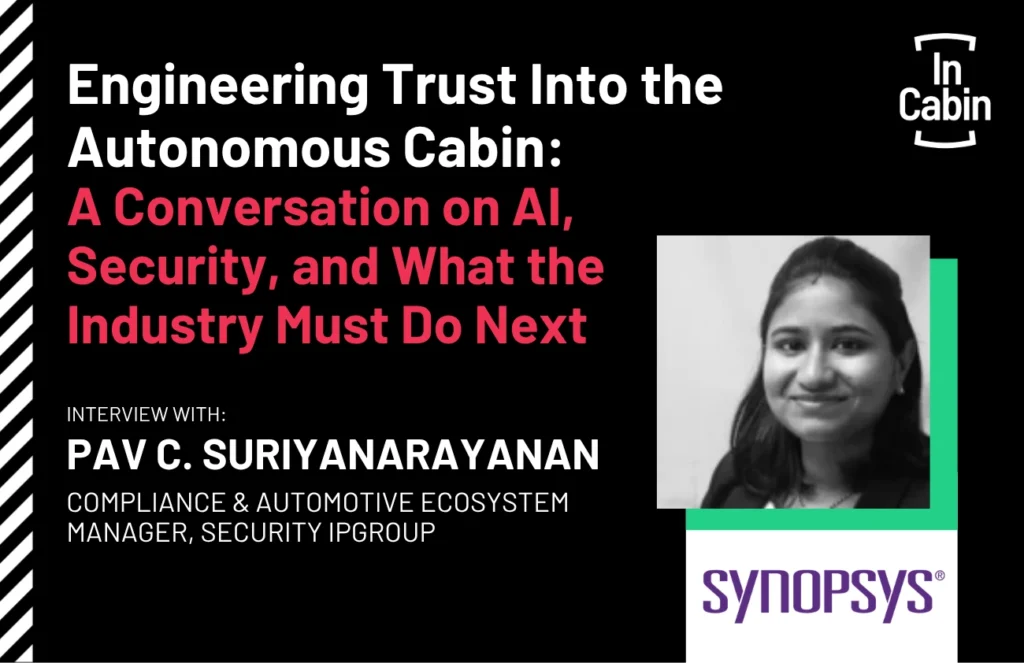
As the cabin becomes human‑aware and autonomy advances, the industry must move beyond intelligent systems to trusted systems where every decision is grounded in verifiable data, secure execution, and hardware‑rooted integrity.
5 Minutes with Carmen Pătrașcu; Tobii’s Single-Camera DMS+OMS Breakthrough

Carmen Pătrașcu talks us through the innovations and breakthroughs Tobii have made with their single-camera DMS+OMS.
The Main Sensing Technologies for ADAS/AV and In-Cabin Applications at Auto China 2026

Brian gives a rundown of all the innovative ADAS/AV and In-Cabin technology highlights showcased at Auto China 2026.
Scaling In-Cabin Safety: From Sensors to System-Level Integration
Scale in-cabin safety with AI, multi-modal sensing, and system-level integration. Insights from Magna and Brighter Signals on data, architecture, and safety.