My First CES
This year was my first time attending CES, and it was a great experience. I started my role with AutoSens just 4 months ago, so I was very happy to be able to go to CES and see all
the new technology and meet all the people making cars safer. It was inspiring going to the various press briefings, analyst tours and variety of booth demonstrations to see the safety driven technology, thank you to everyone who welcomed us to their booths and announcements.
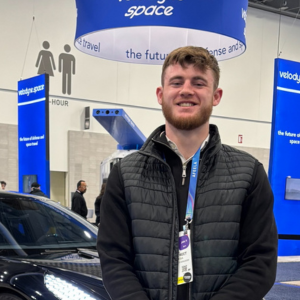
Written by
Will Greenstreet
Business Development Executive

ADAS & AV
Automotive was mainly located in the West Hall. From sensors and compute to full system-level demonstrations, it was the place to be to see the latest developments
in external vehicle sensing, ADAS, automated driving, SDV evolutions, and AI-driven
systems.
What stood out immediately was the scale and maturity of what was being shown.
Many exhibits were no longer conceptual, but clearly focused on production readiness, integration, and real-world deployment. It was clear that this is a pivotal time in the industry and a great sneak peek at what we can expect to see in cars going forwards.
At the event, there was a diverse range of companies showing their updates and developments for radar, LiDAR, camera systems, sensor fusion platforms, and AI perception stacks. One that particularly stood out was Lidwave and their Odem
sensor; on chip LiDAR was not on my 2026 bingo card. It really highlighted the
growing complexity of modern ADAS and AV architectures.
Here are a few key trends that I took away from the show:
- Sensor fusion is now central, with cameras, radar, and LiDAR increasingly designed to work together rather than in isolation.
- AI at the edge is playing a critical role, enabling real-time decision-making while reducing latency and bandwidth requirements.
- Production readiness is becoming increasingly important; many companies were focused on power efficiency, cost, and integration, signalling a move from R&D toward scalable deployment.
In-Cabin Sensing
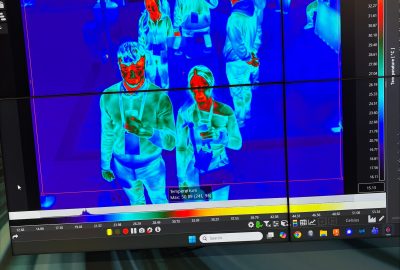
While my focus was primarily on external sensing and ADAS, one strong theme was how AI is reshaping both the vehicle interior and exterior as part of a unified system. Advances in driver monitoring, occupant sensing, and contextual awareness are increasingly being designed to complement ADAS and automated driving functions. Alps Alpine’s demo of a driver monitoring system integrated completely behind the display was a particular highlight for me.
From driver attention monitoring to intelligent displays and human-machine interaction, the emphasis was clearly on human-centric technology. This ensures that as vehicles become more capable, they also become more understandable and trustworthy for users tackling a key issue the industry currently faces.
Growing Connections
The face-to-face discussions are what really reinforced the importance of collaboration across sensors, software, and systems. Meeting engineers, product leaders, and decision-makers from across the automotive ecosystem gave me insight into what to expect this year from the ADAS industry.
Looking Ahead
What struck me most about my first CES wasn’t just the innovation on display, but the pace of convergence. ADAS, automated driving, sensing, AI, and in-vehicle systems are all coming together faster than many expected. From sensing innovators like Alps Alpine and AEVA, to software leaders such as RTI, the future of automotive technology feels increasingly connected. Everything that AutoSens aims to achieve with the industry.
I’m already looking forward to what comes next, and how AutoSens can continue to bring together the engineers and innovators who will turn these technologies into production-ready solutions on roads around the world.