NASCAR is the most followed stock car racing series in the world, and a sport that has witnessed a safety evolution throughout its history. What started as unstructured racing on the beaches of Daytona has now become a highly technologically advanced sport, with top drivers, engineers, technicians, and on-field crew working together to make the cars faster on the track.
As a result, driver safety is treated as a top priority and is addressed through vehicle design, track layout, advanced data acquisition, computer simulations, and rigorous testing. The development of NASCAR driver safety features reflects a sustained effort towards a more proactive, engineering-led approach focused on continuous evaluation and improvement.
Written by:


Early Years: Foundations and safety development
The origins of NASCAR can be traced to Daytona Beach, Florida, where early races were conducted. The events involved production vehicles not purpose-built for racing but modified versions of passenger cars available on the market.
The inaugural 1948 NASCAR rulebook included several safety rules including mandatory seat belts, almost 20 years before they were required in passenger vehicles. While safety has always been a part of NASCAR, early efforts were often based on ‘racer’s intuition’ and experience-based learnings.
As the sport transitioned from beach-road courses to dedicated tracks such as Daytona International Speedway, vehicle speeds increased significantly. This created new safety challenges, as higher speeds directly translated into higher energy levels during crashes. The need for structured safety interventions became increasingly evident.
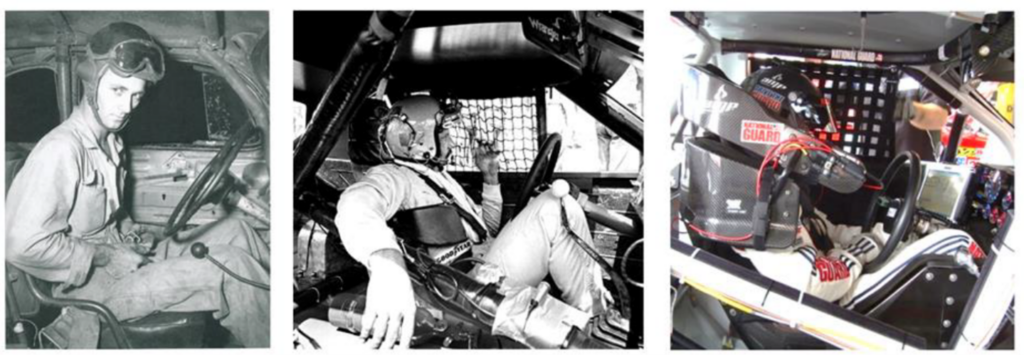
Over the next several decades, NASCAR introduced a series of safety improvements gradually through observation, incident analysis, and collaboration with industry experts. Key advancements included the introduction of fuel cells to reduce fire risk, the use of window nets to prevent limb injuries during crashes, improvements in roll cage design for better structural integrity, enhanced seat systems with multi-point harnesses, and the development of fire-resistant materials and driver safety gear. These changes reflected an evolving understanding of crash dynamics and occupant protection.
Evolution of NASCAR safety
1953
1981
2009
Shift to a Systematic Safety Approach
A significant shift happened following the deaths of four drivers in less than a year, including Dale Earnhardt in the 2001 Daytona 500. The pursuit of safety progressed into a more structured and research-based approach. NASCAR opened a dedicated Research and Development (R&D) Center, and engineering analysis, testing, and validation became important parts of safety improvements.
Driver safety began to be treated as a holistic system involving vehicle crash structures, driver restraint systems, seat and head support geometry, and track-side safety. New equipment such as the head and neck restraints, including the HANS (Head and Neck Support) device, became mandatory, significantly reducing the risk of head and neck injuries. The SAFER (Steel and Foam Energy Reduction) barriers were introduced at the tracks to absorb energy during vehicle impacts and reduce the forces experienced by drivers.
The Next Gen Car: A New Safety Platform
The introduction of the Next Gen car marked another important step in the evolution of safety in NASCAR. This platform was designed not only to improve competition and cost efficiency but also to enhance driver protection through updated structural concepts. Key safety features include a stronger and more uniform chassis structure, improved frontal crash performance, and composite body panels designed for controlled deformation.
Role of Incident Data Acquisition Systems (IDAS) in Crash Analysis
One of the most important advancements in modern NASCAR safety is the use of in-car data recorders. These devices capture detailed information during crash events, such as acceleration and rotational velocities. The data helps to better understand how the car and driver are affected during a crash, going beyond what can be seen visually. Analysis and proper interpretation of the data help provide more information on the crash severity, identify crash patterns, and assist in making improvements in vehicle design and safety systems. The collected data also helps to improve the correlation between real-world crashes and simulation results, leading to more accurate and effective safety improvements.
The IDAS is also linked to an in-car high speed camera system, which captures driver kinematics during a crash event. The synchronized crash data and video footage provide better insight into driver motion and response during a crash event.
Mouthpiece Sensors and Driver-Centric Measurement
A more recent development in NASCAR safety is the wide use of Wake Forest University mouthpiece sensors. These devices are voluntarily worn by drivers and provide a more direct measurement of head kinematics during racing incidents.
Unlike vehicle-mounted sensors, mouthpiece sensors are closely coupled with the driver’s skull, allowing for more accurate estimation of head acceleration and rotational movement. This is particularly important in understanding injury mechanisms related to concussions and other head impacts. The data is being used to develop new material specifications and rules for head surround foams.
The use of such sensors also allows NASCAR to validate driver feedback with quantitative data. For example, if drivers report excessive loading at a particular track section, sensor data can be used to quantify the issue and inform and validate corrective measures.
The combined data from IDAS and mouthpiece sensors is also used to inform track design, helping to identify and reduce conditions that may lead to vehicle incidents.
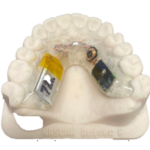
Wake Forest University mouthpiece sensors
Finite Element Simulation and Virtual Testing
Finite Element (FE) simulation has become an important tool in NASCAR safety engineering. It helps to study different crash conditions quickly, check design iterations without the need of physical prototypes, and understand the different deformation modes inside the car structure. FE simulations are used to model both car-to-car and car-to-barrier impact scenarios.
These models are validated through rigorous physical testing and supported by on-track data collected from data acquisition systems. Once validated, these FE models can be used to study many crash cases which are difficult or not possible to test physically, and therefore they play an important role in improving safety.
In addition, state-of-the-art crash dummy FE models, such as Hybrid III and THOR, are used to evaluate different safety and restraint systems in the NASCAR cockpit environment. These include seatbelts, head and neck restraints, as well as seat and head surround foams. Such models help to evaluate the effectiveness of these systems under different crash boundary conditions and support further improvements in overall driver protection. NASCAR also uses advanced human body models (HBMs), which provide an advantage over traditional crash dummies by enabling tissue-level response and helping to predict injuries under different loading conditions. These HBMs also help to improve and fine-tune various injury mitigation systems.
Finite Element Models

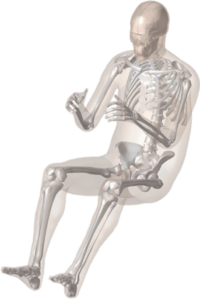
Hybrid III male
THUMS v7 male
Conclusion and Future scope
In conclusion, NASCAR driver safety has evolved over time, from basic protection methods to a more structured and data-based approach. Today, safety is managed through car design, driver restraint systems, track improvements, crash data collection, and simulations. Learning from real crash events and research work has helped to reduce risks and improve driver protection. As more data and understanding become available, safety regulations are also continuously updated to improve safety further.
Future efforts will focus on individual-level safety in addition to the overall safety work that is being done. More effort will be put into testing safety equipment to improve overall driver safety. This includes helmet testing to evaluate both safety and comfort, and to study how helmet mass distribution affects head kinematics during impacts. Different head and neck restraint systems are also being evaluated for their effectiveness in reducing head and neck injuries. FE model studies will also focus on including different driver anthropometries and different seating postures, so that safety systems can be evaluated in more realistic conditions. This will help to improve restraint systems and cockpit design. Use of advanced human body models and better simulation methods will also help to study injury risk more accurately. Overall, these efforts will support further improvement in driver safety and reduction in injury risk in NASCAR.
Interested in exterior sensing technology?
With a pass to InCabin USA, you’ll also get full access to our co-located sister event, AutoSens. Take a look at some of the must see sessions at AutoSens here >>