It was my first time representing Sense Media Group Ltd whilst attending Auto China in Beijing. I saw many black technologies at Auto China 2026 such as: AI & Software-Defined Cars and L3/L4 Autonomy Goes Mainstream.
Highlights also include real-world applications of flying cars (e.g., XPeng’s “Land Aircraft Carrier”) and humanoid robots using autonomous driving technologies and so on, but I want to talk more about the main sensing technologies for ADAS/AV and In-Cabin applications at this year’s show.
Written By:
Brian Bao
Business Development Representative, China

In-Cabin Sensing (DMS/OMS): The Vehicle’s Internal Awareness
Inside the cabin, Driver Monitoring Systems (DMS) and Occupant Monitoring Systems (OMS) have advanced from simple fatigue detection to creating an integrated, smart, and safe space. The key is low-power, high-efficiency computing power that can run these complex AI algorithms without draining the battery.
Dedicated AI Chips for In-Cabin Sensing:
China’s Goke Microelectronics entered the automotive market with mass-produced AI SoC (System-on-Chip) GK1221, delivering 3TOPS of computing power to cover ADAS, CMS, DMS, OMS, AEB and DVR. Advanced AI ISP ensures clear images even in low-light and extreme lighting conditions.
Axera collaborated with multiple Tier-1 suppliers to showcase smart driving and smart cockpit solutions powered by its AI chips, with dedicated demo stations for DMS/OMS applications.
Quectel’s in-cabin AI agent system can perceive driver state, engage in active interaction, and monitor for children or pets left behind after the driver exits.
Jietu Traveler 8 featured intelligent voice interaction powered by iFlytek’s Spark AI large model and DMS fatigue monitoring.
Digital Car Key / Bluetooth / UWB / High-Precision Positioning GNSS: The External Awareness Underpinning Intelligence
Beyond the vehicle’s immediate perception, high-precision connectivity serves as another layer of “external awareness,” ensuring the vehicle is seamlessly connected to infrastructure, the cloud, and the user’s digital ecosystem.
Quectel’s showcased solutions illustrate this connectivity trend well:
High-Precision Fusion Positioning (GNSS+IMU): This technology achieves centimeter-level positioning accuracy with strong anti-occlusion capabilities, specifically engineered to meet the demands of highway NOA and urban NOA driving scenarios.
Digital Car Key (BLE+UWB+NFC): This comprehensive solution integrates Bluetooth Low Energy (BLE), Ultra-Wideband (UWB), and Near-Field Communication (NFC) to deliver a secure and seamless “vehicle-cloud-device” key system.
LiDAR: The Clear Hero of High-Level Perception
LiDAR remained a dominant technology and the clearest indicator of a model’s intelligent capabilities.
High-End Benchmark (896-Line): Huawei took a clear lead with its mass-produced 896-line dual-optical-path image-grade LiDAR, which set the industry standard in terms of specifications. Compared to previous generations, its module thickness was reduced by 40% and resolution was enhanced by 400%, enabling stable detection of obstacles as small as a soda can from 120 meters away. This technology was prominently featured in models such as the Qijing GT7 and AITO M9, as well as the Shangjie Z7 series, which was equipped with Huawei’s ADS4.1 system integrating an 896-line dual-optical-path laser radar as part of its comprehensive hardware suite.
Powerful Integrators (Multi-LiDAR Solutions): The use of multiple LiDAR units to create 360° coverage was the standout feature for flagship SUVs.
AITO M9 became a foil for Huawei’s sensor-heavy scheme, integrating a staggering total of 38 environmental perception sensors, which included an 896-line unit and three additional high-precision solid-state LiDARs.
NIO continued to showcase its Aquila super-sensing system on models like the new ES8, which comprised 31 intelligent sensors, including three LiDAR units.
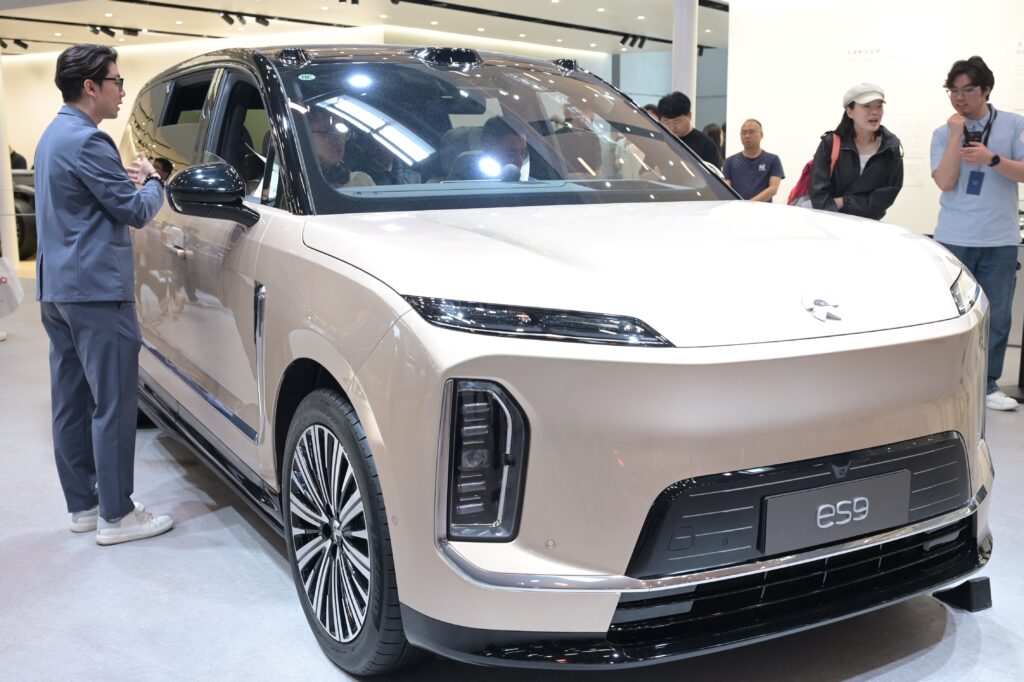
Li Auto advanced its high-spec competitive play with the L9 Livis, packing two self-developed M100 LiDAR chips alongside its core sensing suite.
Seyond (Innovusion) presented its comprehensive lineup. Its latest-generation Falcon K3 LiDAR boasted a detection range of 900 meters and a 300%+ improvement in angular resolution compared to the previous Falcon K2, paving the way for hardware pre-installation for L3/L4 autonomous driving.
Hesai showed off a 420-line ultra-view LiDAR on the IM Motors LS7, offering equivalent perception capability of up to 1040 lines.
Mainstream Adoption: Reflecting the industry trend of “universalizing” intelligent driving, several automakers introduced LiDAR as a standard feature to achieve high-level perception at lower price points. For instance, GAC Aion N60 came standard with a 192-line LiDAR priced below the RMB 150,000 (approx. $20,000) threshold.
4D Imaging Radar & Millimeter-Wave Radar: The Backbone in All Weather
4D imaging radar emerged as a key complement to LiDAR, providing high-resolution perception independent of lighting and weather conditions, thus forming a crucial part of the sensor fusion strategy alongside cameras.
Auto China 2026 solidified the combination of LiDAR + 4D millimeter-wave radar as a new benchmark for high-end intelligent driving functions. Notably, this “golden combination” was popularized on various models, such as the Audi Q5L (2 LiDAR units + 6 millimeter-wave radars), the Z7 series (896-line LiDAR + multiple 4D millimeter-wave radar), the new NIO ES8 (4D imaging radar included in sensors), and the GAC Aion N60 (192-line LiDAR + 4D millimeter-wave radar).
New Architecture: Satellite Radar: A compelling trend was the emergence of “satellite radar” architecture, which moves processing to a central domain controller. This reduces the size, power consumption, and cost of the radar nodes themselves.
In a significant “China Innovation, for the World” move, the global technology company Aptiv debuted its Chinese-team-developed “satellite-style architecture 4D millimeter-wave radar,” characterized by a streamlined design with an air waveguide antenna and a single RF chip.
Quectel also showcased its central computing satellite architecture millimeter-wave radar complete solution. This system is built around one forward 4D imaging radar and four corner radars, creating a 360° perception system.
Camera & Vision Perception: The AI-Powered Eyes
Cameras are the primary source of data for AI-driven perception systems, especially for reading the surrounding environment. The shift was moving from seeing the world to “understanding” the physical world through AI models.
E2E Large Models & World Models (Physical AI): The entire industry’s focus is on AI large models. Crucially, discussions about the count of LiDAR sensors have largely faded, replaced by a focus on the underlying capabilities of AI foundation models.
Momenta’s R7 reinforcement learning world model officially entered mass production, enabling AI to compress physical laws, common sense, and causal relationships from massive datasets.
DeepRoute.ai rolled out its 40 billion-parameter autonomous driving base model, capable of unifying driving decisions, scenario understanding, and safety assessment.
Zhuoyu Technology (DJI’s automotive arm) shifted the paradigm by releasing its new native multimodal foundation model, which can unify and represent video, text, voice, maps, and action—allowing a single model to handle perception, planning, and decision-making.
Summary: The Shift from Quantity to Quality and "Physical AI"
Auto China Beijing 2026 demonstrated a decisive pivot from hardware quantity to AI capability as the central battleground for automotive intelligence.
The sensors themselves are not the story, but they are the essential bedrock upon which the story of “Physical AI” is being built. The industry has moved beyond the “how many LiDARs” debate and is now racing to implement world models and foundation models that can understand the physical world.
A clear division of labor has emerged: LiDAR provides ultra-high-resolution, long-range spatial data; 4D imaging radar ensures reliable high-resolution perception in adverse weather; vision via AI is evolving to truly understand the physical world; and in-cabin sensing is redefining the vehicle’s relationship with its occupants.
The main sensing technologies in vehicles have evolved from being mere “sensors” to becoming the “neurological system” of a highly intelligent mobile robot. The path to fully autonomous driving is being paved with a fusion of powerful, mutually-reinforcing sensing technologies.
Want to get involved?
Join fellow engineers and specialists sharing innovations and breakthroughs at AutoSens. Contact Brian to partner with us and get involved: brian@sense-media.com

Technical deep dives & Interviews; Explore what InCabin has to offer ⬇