Written by:

Becky Wells
Freelance Automotive Journalist
InCabin USA hosted its annual Detroit conference this June, returning with co-hosts AutoSens USA. The event offered a packed programme of in-depth tutorials, expert-led roundtables and an exhibition floor showcasing the latest innovations and advancements in ADAS technology.
On Wednesday 10th June, some of the InCabin exhibitors participated in a joint press conference, announcing new products and sharing updates on the latest technological advancements. Key topics included new and improved hardware across both internal and external sensors, as well as developments of safety software, AI enhancements and improved data management.
Read on for a recap of the presentations made by Brighter Signals, Cirrus Logic, Embedded AI, IEE Sensing, Sony Semiconductor Solutions, Aptiv, rFpro, and indie during InCabin USA 2026.
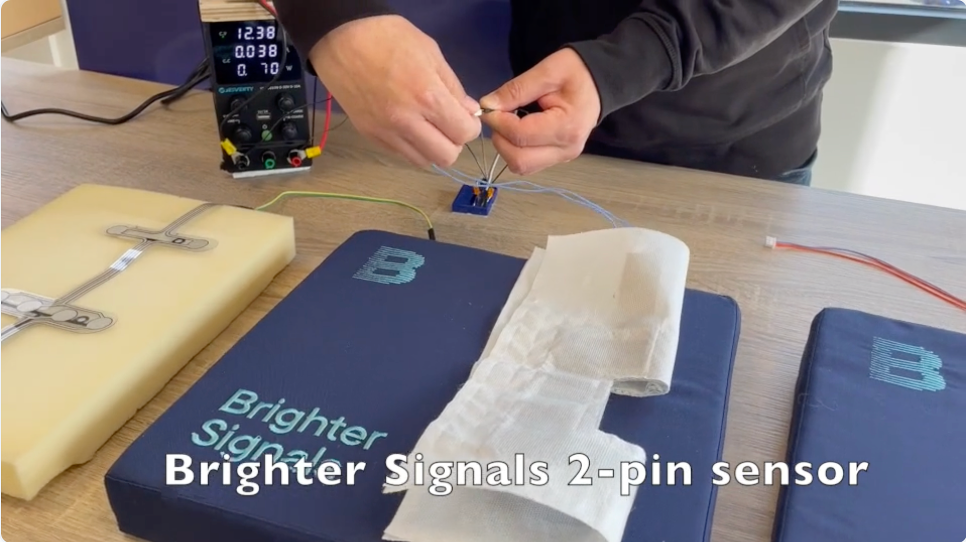
Brighter Signals used InCabin USA 2026 to introduce its next-generation Seat Belt Reminder (SBR) sensor. The new fabric-based sensing solution was designed as a direct replacement for the binary seat occupancy sensors that have dominated the market for nearly two decades.
Unlike traditional systems that rely on a simple weight threshold, the new SBR sensor captures weight distribution across the seat surface. This enables more reliable identification of occupants, particularly children, teenagers and smaller adults who are often missed by traditional systems when seated off-centre. The technology also helps reduce false alerts caused by bags and other objects placed on seats.
A key advantage of the new sensor is its drop-in compatibility with existing two-pin seat electronics architectures. OEMs can deploy the technology without redesigning ECUs, wiring harnesses or vehicle software, allowing manufacturers to improve safety performance without introducing additional cost or integration complexity. Brighter Signals believes the solution addresses a long-standing gap in occupant detection performance while providing a practical path toward improved seatbelt reminder functionality across current and future vehicle platforms.
Presenting at the conference, Andrew Klein, Co-Founder and CEO of Brighter Signals, said: “SBR is one of the most complained-about systems in the modern vehicle, and the technology underneath it hasn’t meaningfully changed in twenty years. Our SBR sensor slots directly into the existing 2-pin ECU footprint, costs no more than the binary sensor it replaces, and brings a meaningful step-up in accuracy. For an OEM, this is the rarest kind of upgrade – better performance, same cost, no integration project.”
Cirrus Logic announced its first family of automotive-qualified closed-loop haptic drivers, bringing technology originally developed for premium consumer electronics into the automotive interior.
The new CS40L5x devices have been qualified to the AEC-Q100 automotive reliability standard and are designed to enhance tactile feedback across a growing range of in-vehicle interfaces. As automotive interiors continue to replace physical buttons with touchscreens and smart surfaces, realistic haptic feedback has become increasingly important for both usability and safety.
The new driver family uses advanced closed-loop control algorithms to improve actuator response times, expand available frequency ranges and deliver more consistent performance across varying temperatures and manufacturing tolerances. This allows designers to create more immersive and intuitive tactile experiences on displays, steering wheels, centre consoles and other interactive surfaces.
By offering scalable solutions for different performance levels and budgets, Cirrus Logic aims to help automakers create premium user experiences while reducing driver distraction through more natural and responsive human-machine interfaces.
“Consumers expect a high level of responsiveness from haptics experiences. Early adoption of haptics in vehicles was not intuitive or consistently reliable, and didn’t deliver a realistic tactile experience,” said Vlad Bulavsky, Director of Automotive Solutions at Cirrus Logic.
“Cirrus Logic’s new low-latency, closed-loop haptics technology addresses this challenge for automotive designers who are redefining how we interact with our cars and take user experience to the next level.”
Embedded AI introduced X-UWB™, a new automotive Ultra-Wideband platform designed to transform existing UWB secure-access infrastructure into a multifunction sensing backbone.
Traditionally used for digital key and secure ranging applications, UWB technology is increasingly capable of supporting sensing functions through advances in automotive chipsets. X-UWB leverages these capabilities to combine secure access, interior and exterior sensing, advanced localisation and vehicle-to-infrastructure interaction on a shared hardware platform.
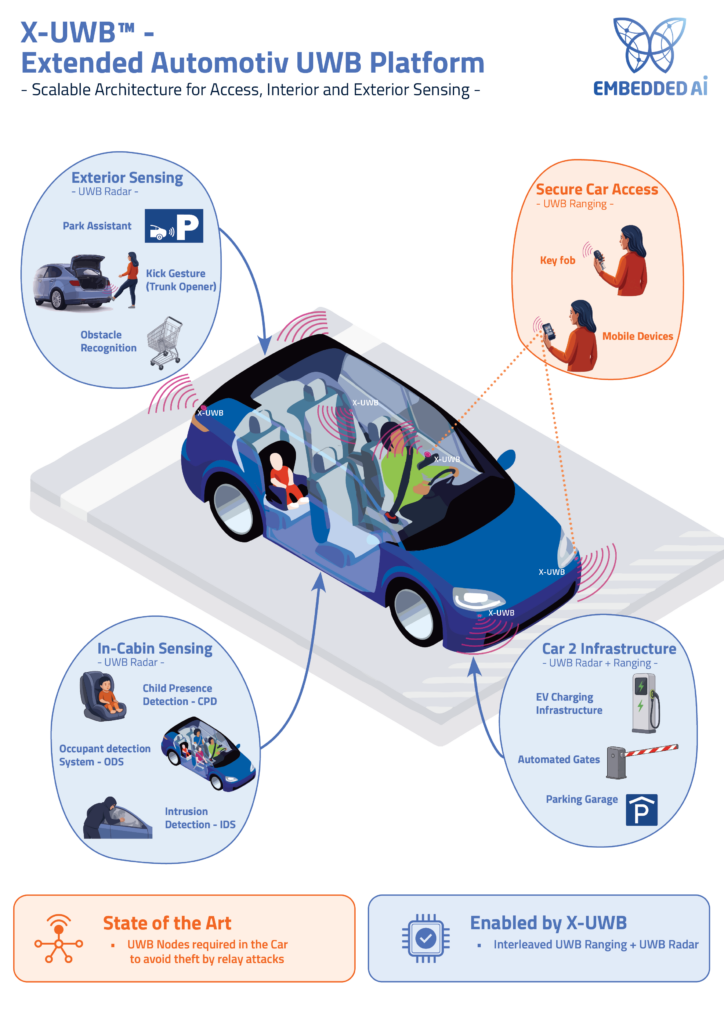
The company highlighted applications including child presence detection, intrusion monitoring, breathing-related motion detection and personalised seating configurations. By consolidating multiple functions into a common UWB architecture, OEMs may be able to reduce the number of dedicated sensors, simplify wiring and lower integration complexity.
Embedded AI positions X-UWB as a software-defined platform that allows manufacturers to activate new capabilities through software rather than additional hardware. This aligns with broader industry trends toward sensor consolidation and scalable vehicle architectures.
“X-UWB represents a shift from UWB as a single-purpose access technology to UWB as a scalable vehicle sensing platform,” said Dr. Rico Petrick, CEO at Embedded AI. “By reusing the hardware foundation already required for secure access, OEMs can reduce integration complexity while enabling new safety, comfort and differentiation features through software-defined packages.”
IEE Sensing presented the evolution of its Sensor Fusion technology, highlighting how the integration of multiple sensing modalities is becoming essential for next-generation cabin intelligence systems.
The company explained that modern in-cabin monitoring systems are evolving beyond simple occupant detection towards comprehensive real-time understanding of vehicle interiors. By combining information from multiple sensor types, Sensor Fusion enables vehicles to better interpret occupant behaviour, assess risk and respond appropriately to changing conditions.
As safety regulations and consumer expectations continue to evolve, Sensor Fusion is increasingly viewed as a foundational technology for future occupant monitoring, child presence detection, driver monitoring and comfort features. The approach enables improved robustness compared with single-sensor systems, while helping manufacturers address increasingly complex use cases.
Hector Guzman, Engineering Director at IEE Sensing, said at the conference: “Sensor Fusion is the enabler for future in-cabin sensing needs where different sensor technologies will have to interact to deliver the best performance and experience to the OEMs and end-users.”
Sony presented at InCabin USA with its INOV demonstration vehicle, showcasing a broad portfolio of interior and exterior sensing technologies, as well as software solutions designed to support emerging safety and comfort requirements.
The key announcement was the planned production launch of Sony’s IMX775 automotive image sensor, scheduled for the second quarter of 2027. The company also highlighted its extensive experience in 3D sensing technologies, which have already been deployed in production vehicles for more than a decade.
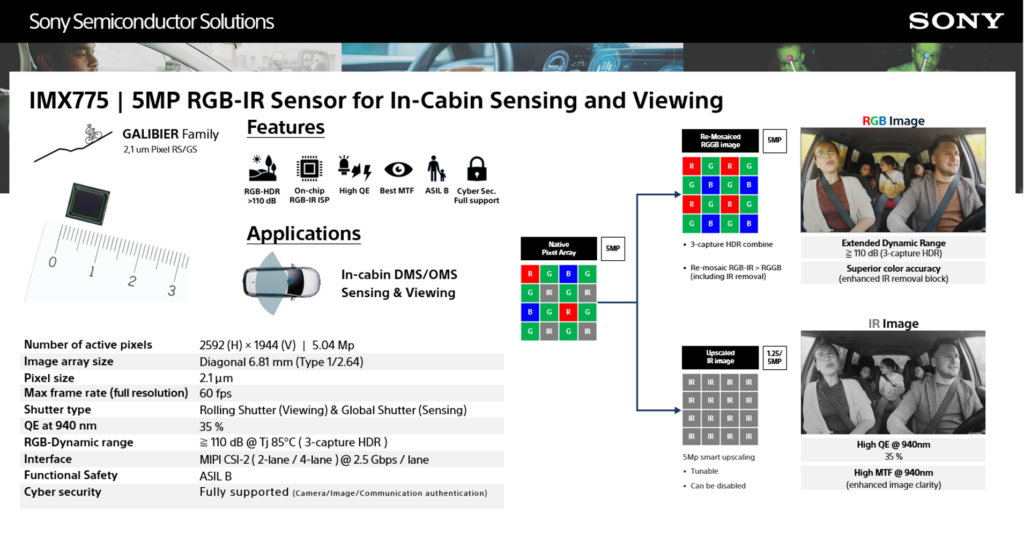
At the event, attendees were able to experience Sony’s RGB, RGB-IR, and indirect Time-of-Flight sensing solutions, alongside the company’s technology-agnostic Occupant Monitoring System software platform. The OMS software can operate with both 2D and 3D sensors, providing flexibility for manufacturers seeking to meet regulatory requirements while maintaining platform scalability.
The presentation reinforced Sony’s strategy of combining advanced sensing hardware with perception software, enabling OEMs to deploy complete interior monitoring solutions across a range of vehicle architectures.
Aptiv unveiled its Advanced Occupancy Classification (AOC) system, which the company describes as the industry’s first production-ready camera-only occupant detection platform.
The system represents a significant shift away from traditional pressure and weight sensors embedded within vehicle seats. Instead, AOC uses an existing cabin monitoring camera combined with AI-powered software to determine occupant status, seating position and conditions relevant to airbag deployment decisions.
By eliminating dedicated in-seat hardware, Aptiv believes manufacturers can reduce system costs by up to 40% while simplifying vehicle architecture and enabling greater design flexibility. The approach also removes seat wiring and associated hardware, helping reduce vehicle weight and manufacturing complexity.
Beyond regulatory compliance, the company sees AOC as a foundation for future intelligent cabin capabilities, delivering more than fifteen occupant-awareness functions through a software-defined platform. The technology supports both current safety requirements and future smart-cabin applications while aligning with industry trends toward sensor consolidation.
Simulation specialist rFpro announced ‘AV elevate IN CABIN’, a new simulation environment specifically developed for driver and occupant monitoring system development.
The launch comes as Euro NCAP significantly increases the weighting of in-cabin monitoring technologies within its 2026 assessment protocols and as Advanced Driver Distraction Warning requirements become mandatory under European regulations.
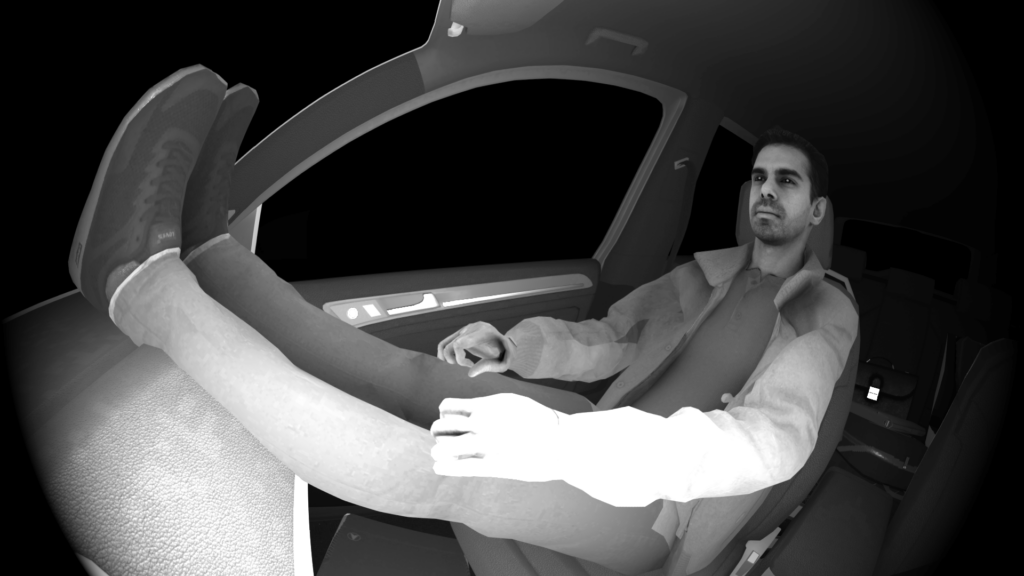
The platform enables OEMs and sensor developers to tune, train and validate monitoring systems before physical prototypes exist. The simulation environment incorporates highly detailed vehicle interiors, realistic occupant behaviour, radar-aware cabin structures and advanced IR camera modelling to accurately replicate real-world sensing conditions.
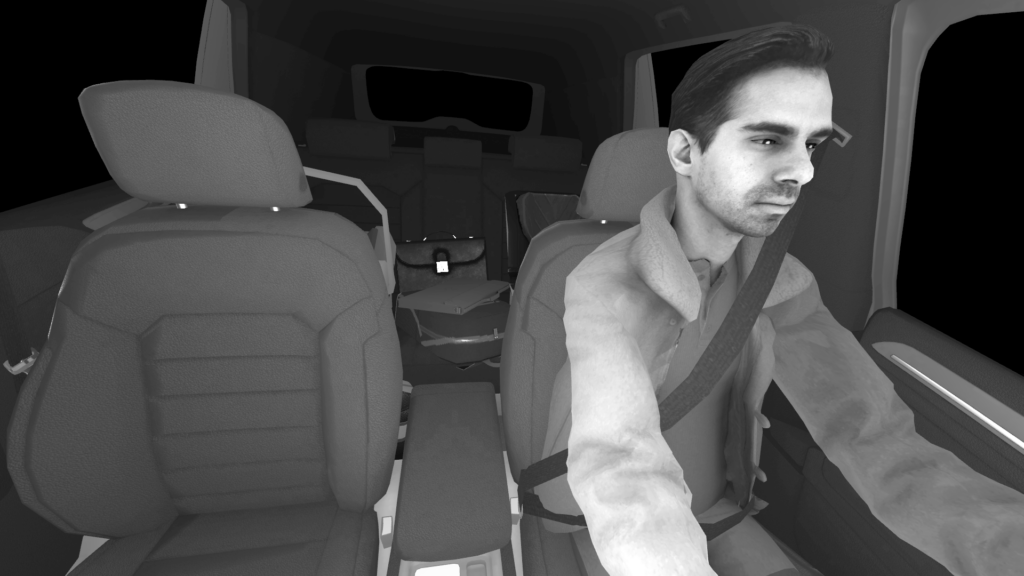
A library of preconfigured Euro NCAP scenarios further accelerates development by allowing engineers to evaluate systems against emerging regulatory requirements. By extending its simulation expertise from exterior sensing into cabin monitoring, rFpro aims to provide a unified environment for the development of both ADAS and in-cabin technologies.
Additionally, rFpro showcased the integration of Xylon’s ISP Studio within its simulation environment, marking the first time the combined solution has been demonstrated at the event. Building on previous work integrating Sony CMOS sensor technology into simulation workflows, the new capability enables developers to model and fine-tune image signal processor (ISP) parameters directly within a virtual environment.
Matt Daley, Technical Director at rFpro, said at the conference: “Euro NCAP’s 2026 scoring changes make in-cabin monitoring one of the most consequential areas of vehicle safety development. ‘AV elevate IN CABIN’ is a physically accurate, engineering-grade simulation environment enabling thousands of tests to be conducted before anything physical has even been built.”
Indie Semiconductor used InCabin USA to introduce its new iND881 edge AI system-on-chip (SoC), a processor platform developed to power intelligent automotive vision systems and next-generation robotic perception applications.
The iND881 integrates a Neural Processing Unit (NPU), Digital Signal Processor (DSP), and quad-core Arm CPU architecture into a single platform, enabling real-time AI inference with low power consumption. Designed to support a broad range of sensor technologies, the platform is compatible with visible-light and infrared cameras, thermal sensors, radar, LiDAR, and time-of-flight systems.
Within the automotive sector, the chipset is aimed at applications such as driver and occupant monitoring systems, digital mirrors and other AI-powered perception functions. Beyond vehicles, indie highlighted the platform’s potential for use in humanoid robotics and industrial automation, reflecting growing demand for edge AI capabilities across multiple industries.
The company also showcased the integration of emotion3D’s established DMS and OMS software with the iND881 platform, offering OEMs and Tier 1 suppliers a streamlined hardware-and-software solution designed to simplify development and accelerate deployment timelines.
Speaking on the launch, Fred Jarrar, Senior Vice President of Product Line and Business Management at indie, said “With the launch of iND881, we are not only expanding our portfolio but realising the exciting and expansive opportunities in edge AI markets such as automotive and humanoid robotics. By offering our industry-leading SoC solution as an independent platform or combining it with indie’s emotion3D AI perception software, we are truly differentiating ourselves as a complete solutions provider, while providing customers the flexibility to choose their preferred design approach.”
Conclusion
The announcements at InCabin USA 2026 highlighted the rapid development of sensing hardware, AI software, connectivity and data management technologies across the automotive industry.
A common theme throughout the event was the move toward software-defined architectures and sensor consolidation, enabling manufacturers to reduce complexity while expanding functionality. Companies also demonstrated growing focus on meeting emerging safety regulations through advanced occupant monitoring, improved perception systems and more comprehensive validation methodologies.
The technologies presented at InCabin USA 2026 help illustrate how the automotive industry continues to build the foundation for safer, more intelligent and increasingly autonomous vehicles.
Read more at InCabin USA
Interested in exterior sensing technology?
By joining us at InCabin, you’ll also get full access to our co-located sister event, AutoSens. Take a look at the press recap from AutoSens USA here >>