Written by:

Modern vehicles are rapidly becoming software-defined, and with that shift comes a new expectation for perception: higher fidelity sensing, lower latency decision-making, and a platform that can scale across trim levels and regulatory regions without reinventing the hardware each time. Radar sits at the center of this evolution because it delivers robust perception in conditions where other sensors can degrade- fog, rain, snow, spray, and low light- making it a foundational technology for next-generation ADAS and automated driving stacks.
Why radar architectures are changing
For years, most automotive radar systems have relied on a decentralized model: each radar module performs significant signal processing locally, generates an object list or limited point cloud, and forwards those results to the ADAS ECU over relatively low-bandwidth in-vehicle links. This approach has been effective, but it is increasingly constrained by the compute and memory available at the sensor edge. It also creates a structural barrier to “true” sensor fusion because each radar makes independent decisions before the vehicle’s central compute ever sees the underlying data.
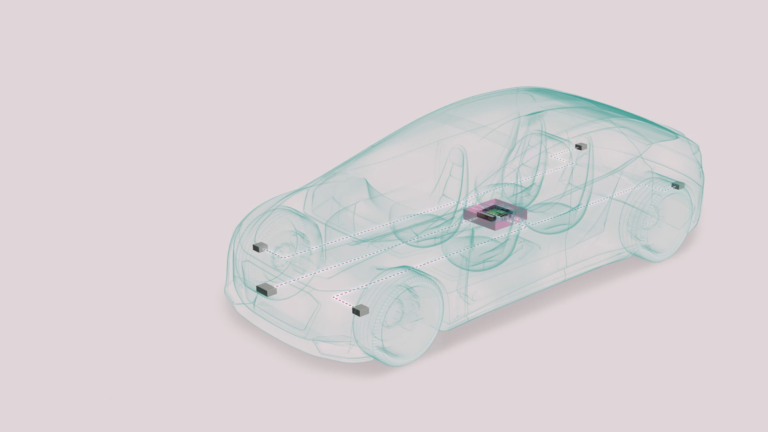
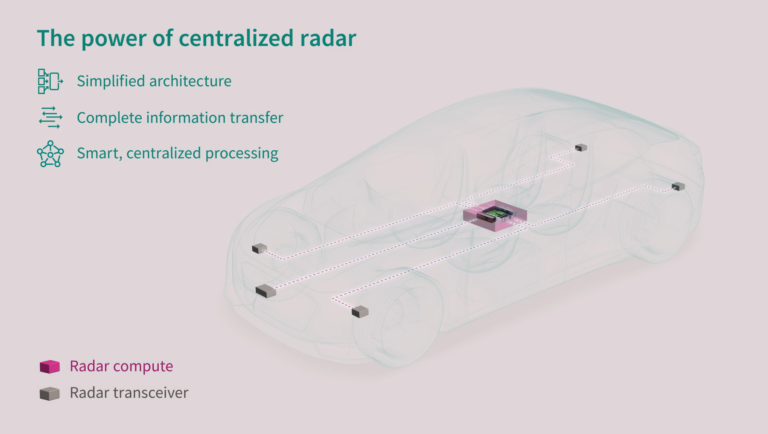
As perception functions expand- more difficult VRU scenarios, denser traffic, higher speed closing events, and tighter safety requirements—the industry is moving toward a centralized processing model. In this setup, radar heads act as “raw ADC satellite sensors,” streaming unprocessed data directly to a central ADAS ECU where advanced algorithms can run with far fewer resource constraints.
What centralized raw-ADC processing enables
Centralizing radar processing does more than rearrange where compute happens, it unlocks fundamentally better perception behavior.
1. Higher sensitivity and richer radar data: With advanced processing performed on central compute, radar sensitivity and point density increase, improving detection range and signal-to-noise ratio. That extra margin matters: earlier detection expands time-to-collision windows, enabling smoother braking and steering interventions and reducing reliance on abrupt emergency maneuvers—benefiting both safety and passenger comfort.
2. Better fusion, lower latency, more consistent perception: When radar data is consolidated in a unified compute domain alongside camera and LiDAR inputs, it becomes possible to perform deeper forms of fusion with improved time synchronization and cross-sensor correlation. This supports tighter fusion loops and lower latency in the perception stack. The architectural trajectory mirrors what has already happened in camera systems, where sensors increasingly stream data to centralized processors rather than performing heavy computation in each camera module.
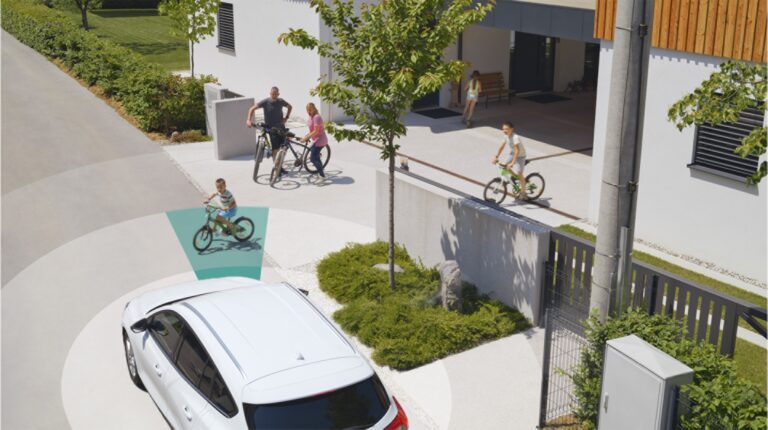
3. Improved tracking, classification, and free-space understanding: Central ECU processing exposes algorithms to more complete information. The result is measurable improvement across key perception outcomes: detection, classification, tracking, free space estimation, latency, and overall fusion performance—directly enhancing safety, comfort, and functional scalability for next-generation ADAS. In practical terms, that translates to more robust multi-target tracking, higher localization accuracy, and improved detection of vulnerable road users (VRUs).
4. More efficient radar modules: Centralized processing eliminates the high-performance MCU in the radar head. Removing that edge compute reduces radar-module power dissipation by approximately 20–40%, easing thermal constraints, simplifying housing requirements, and improving long-term reliability. For EVs, lower sensor power optimizes energy budgets and contributes to increased driving range.
What does this mean for the AutoSens and InCabin communities?
AutoSens and InCabin has always been a forum where sensing meets implementation reality: architectures, interfaces, compute distribution, and the practicalities of deploying robust perception at scale. Centralized radar processing is a prime example of this convergence. It is not just a sensor story, it’s an end-to-end platform story involving signal chain design, in-vehicle networking, central compute scheduling, fusion strategy, functional safety, and upgradability in a software-defined vehicle world.
For engineering teams, the conversation is shifting from “How good is this radar module by itself?” to “How well does this radar contribute to the vehicle’s unified perception system?” Central processing of raw ADC data is a powerful lever to improve the answer —delivering richer inputs, more advanced algorithms, and tighter cross-sensor reasoning, without being boxed in by edge compute limits.
Bringing centralized radar to market with Infineon’s RASIC™ 77/79 GHz ADAS FMCW radar sensor ICs
As the industry adopts centralized architectures, hardware platforms that simplify integration and preserve RF performance become essential. Infineon supports these concepts with its RASIC™ family of 77-79 GHz automotive radar MMICs. Specifically, the RASIC™ CTRX8191F and CTRX8188F deliver best-in-class RF performance and scale effectively within centralized processing designs.
The RASIC™ CTRX8188F (8 transmit / 8 receive channels) is designed to support the latest L2 regulation for China, reflecting the growing need for globally adaptable radar platforms.
To accelerate development, Infineon provides the RASIC™ CTRX 77 GHz 8Tx 8Rx ADAS radar evaluation kit, which simplifies the integration of raw ADC satellite radar heads into central ADAS ECUs. As a pre-validated, modular solution with standardized interfaces, the CARKIT reduces development time and cost, offering a scalable path to centralized radar processing. For OEMs and Tier 1s, Infineon’s combination of RASIC™ centralized-ready sensors and the practical CARKIT integration platform provides a strong foundation for next-generation ADAS.
Learn more about Infineon’s RASIC™ 77/79 GHz automotive radar sensor ICs or request an evaluation kit.
References:
Infineon Technologies AG: Centralized architecture for automotive ADAS/AD radar based on raw-ADC-data whitepaper; Available online
Interested in exterior vehicle sensing technology?
With a pass to InCabin Europe, you’ll also get full access to our
co-located sister event, AutoSens. Find out more here >>