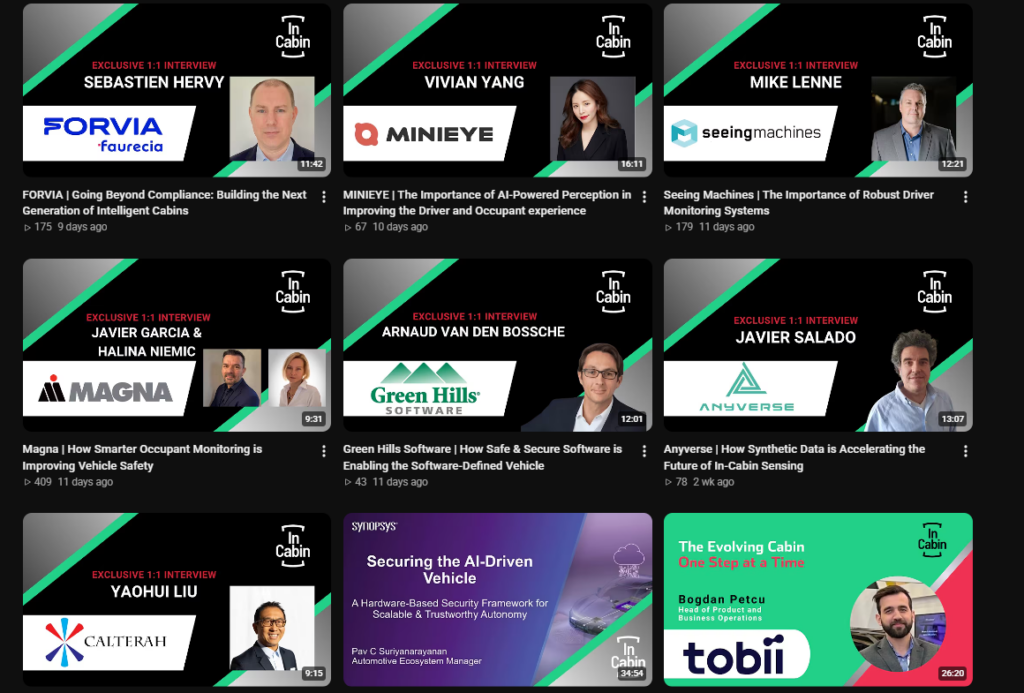

This year’s InCabin Europe event took place in Barcelona this September, taking place alongside AutoSens at La Farga de L’Hospitalet. Over three days, the event brought together OEMs, Tier 1 suppliers, automotive engineers and technology developers working across in-cabin sensing, alongside a packed programme of technical tutorials, roundtables and an exhibition showcasing the latest hardware and software developments.
Wednesday 23rd September saw a selection of exhibitors take to a joint press conference, where they unveiled new sensors, chipsets, simulation technologies and platforms, spanning both exterior and interior sensing. Several themes emerged across the announcements, including the growing role of synthetic data and simulation in meeting Euro NCAP’s tightening in-cabin protocols and the development of agentic AI inside the cabin.
Read on for more news of the event’s announcements, and learn more about InCabin here.
“We can’t replace physical testing.”
At the InCabin Europe press briefing, Aptiv introduced its In-Cabin Synthetic Data Platform, a new virtual validation tool designed to help OEMs generate and test cabin scenarios at scale. The announcement set out Aptiv’s wider vision for the cabin as a sensing, understanding and adaptive space, built on the company’s LINC software platform.
With physical testing struggling to cover the growing range of occupants, behaviours and cabin environments required to validate DMS and OMS systems, Aptiv sees synthetic data as a way to move more of that work into the virtual environment. The company said its platform can reduce validation costs by up to 70% compared with traditional physical testing, while allowing systems to be assessed much earlier in the development cycle, from initial vehicle architecture and CAD through to prototyping and production. Aptiv highlighted its existing camera-only Advanced Occupancy Classification (AOC) system as one example of an AI-powered in-cabin technology that could benefit from this approach to synthetic validation.
“We can’t replace physical testing. It’s very important to understand that virtual testing is an extension of physical testing and not a competing solution,” said Craig Turner, VP & Managing Director for In-Cabin Experience and SDV Software Platform. Aptiv said its own internal validation work currently follows roughly an 80/20 split between physical and virtual testing, with synthetic data used to let engineers test every change before a smaller number of final validation runs are carried out in a real vehicle.
“Radar can overcome some of those challenges and enable new applications.”
Korean AI company Deep In Sight showcased an in-cabin multimodal sensing proof of concept, developed jointly with Murata. This combines Deep In Sight’s Vision AI-based driver and occupant monitoring software with a 60 GHz in-cabin radar from Murata. The fusion system is designed to detect and interpret occupant presence, position, movement, state and behaviour more reliably than either sensing modality can achieve alone, helping validate a more robust approach to in-cabin monitoring for OEM and Tier 1 customers.
The company also presented its rPPG (remote photoplethysmography)-based vital sensing technology, which uses standard in-cabin camera images to estimate heart rate and other vital signs from drivers and occupants without physical contact, extending conventional safety monitoring toward broader driver and occupant condition monitoring.
Presenting the technology, Deep In Sight CTO Inchan Ji explained that the radar is designed to catch cases that might be missed by a camera alone, such as a child hidden from the camera’s view behind a front seat, where radar can still detect breathing or heartbeat. It also enables a low-power intrusion-detection mode, in which the radar runs continuously to detect someone entering or lingering around the vehicle before waking the camera to confirm the situation.
“Cameras have clear limitations, but radar can overcome some of those challenges and enable new applications,” said Ji. “The remaining consideration is cost, but radar systems are becoming much more affordable than camera-based systems. That creates a real opportunity for OEMs and Tier 1 suppliers to consider adding new sensing capabilities to their vehicles.”
“Implementing the virtual assessment framework is a complex undertaking.”
Synthetic data specialist Anyverse announced the launch of its Virtual Assessment Implementation Program (VAIP), a new technical programme designed to help OEMs and Tier 1 suppliers operationalise Euro NCAP’s upcoming 2029 virtual assessment framework. Working in coordination with Euro NCAP’s Virtual Testing Assessment working group, the programme brings together a founding group of manufacturers and suppliers to jointly build validated scenario datasets, physics simulation models and the regulatory documentation needed to demonstrate simulation validity to assessors, with membership free to qualifying OEMs and Tier 1s.
“The industry has clarity on where Euro NCAP is heading, but implementing the virtual assessment framework at the required level of technical rigour is a complex undertaking,” said Victor Gonzalez, CEO of Anyverse. “The VAIP provides a structured, shared path to build that foundation, and we expect the organisations that engage now to be the ones setting the benchmark when the 2029 standard arrives.”
The programme is initially focused on driver monitoring, with Gonzalez saying it could later extend to occupant monitoring and other modalities as Euro NCAP’s virtual assessment framework develops. Anyverse said the resulting datasets, workflow specifications and evidence pack will be made public rather than kept proprietary, describing the goal as giving the industry a shared, common resource rather than a competitive advantage for Anyverse alone.
“We’re seeing the geopolitical landscape become increasingly important.”
Brighter Signals used InCabin 2026 to announce that Bill Russo, Founder and CEO of Shanghai-based mobility advisory firm Automobility, will join the company’s Board of Directors as an independent director. The appointment reflects the growing importance of China to Brighter Signals’ strategy, both as the location of its manufacturing base with partner CAIP Ltd in Changshu, and as an increasingly influential source of the feature and technical standards shaping in-cabin design globally.
Speaking of the appointment, Andrew Klein, Co-Founder and CEO of Brighter Signals, said, “It has helped us understand the opportunities and challenges at a much more granular level. China is now leading innovation in many areas, particularly in the in-cabin space, and we’re learning a great deal about the applications, features and consumer benefits that are driving that innovation.
“We’re also learning from the way Chinese EV leaders approach innovation, which is markedly different from what we’ve experienced in Europe and the US. With the success of Chinese EV brands, particularly in Europe, we’re seeing the geopolitical landscape become increasingly important. We now have a much better understanding of the opportunities and challenges ahead, but there is still a lot to learn.”
Presenting the technology behind the news, Klein described Brighter Signals’ electrified fabric platform, which is soft, flexible and low cost, and can map weight distribution across an array of sensors to sense the proximity of a body or body part. Its most mature application is a new generation of seat occupancy classification, using thin fabric sensors placed under the seat trim at around half the cost of existing technology, which Klein said meets both US and European occupant classification standards.
“It enables thousands of tests to be conducted before anything physical has even been built.”
Simulation software specialist rFpro used InCabin to launch AV elevate IN CABIN, a new add-on package that enables developers to tune, train and test driver and occupant monitoring systems in simulation, long before physical prototypes exist. The launch responds to Euro NCAP’s 2026 protocol changes, which have sharply increased the weighting of driver monitoring and child presence detection within a vehicle’s overall safety score, alongside the EU’s General Safety Regulation, which makes Advanced Driver Distraction Warning mandatory for new vehicles from July 2026.
The new package improves the fidelity of rFpro’s virtual cabin interiors, including radar-visible sub-structures within seats and an expanded object library covering items such as rucksacks, laptops and child seats. There’s also a high-density bone rig for simulating the fine facial and limb movements that driver monitoring systems must detect. Its new IR camera sensor model accurately replicates how infrared energy interacts with cabin surfaces, with material properties correlated against laboratory measurements from the Sim4CamSens research programme.
A pre-configured library of Euro NCAP test scenarios is also included, making rFpro the only simulation platform to support both exterior and in-cabin sensor development within driver-in-the-loop, hardware-in-the-loop and software-in-the-loop environments.
“Euro NCAP’s 2026 scoring changes make in-cabin monitoring one of the most consequential areas of vehicle safety development,” said Matt Daley, Technical Director at rFpro. “We have taken our proven exterior simulation solution and applied the same techniques to the interior. AV elevate IN CABIN is a physically accurate, engineering-grade simulation environment enabling thousands of tests to be conducted before anything physical has even been built.”
“OEMs can select the approach that best fits their cost and integration requirements.”
Presenting at InCabin Europe for the first time, Chinese radar and UWB semiconductor specialist Calterah showcased a live Parking Assist System demonstration powered by its Dubhe CAL1106AQ SoC. The company says the device is the first UWB chip to incorporate the sensing capabilities specified by the IEEE 802.15.4ab standard.
The CAL1106AQ combines a 2T4R architecture with Radar Leakage Suppression to deliver centimetre-level height and velocity sensing, going beyond those offered by conventional ultrasonic sensors. Its multi-anchor synchronisation and slot-level frame interleaving also enable radar and ranging functions to operate simultaneously, supporting applications such as the detection of people and obstacles behind a vehicle in line with UN R158 requirements.
The company’s EMEA FAE & Marketing Manager, Yaohui Liu, also outlined the different considerations for OEMs choosing between Calterah’s 60 GHz radar and UWB technologies for child presence detection. UWB can make use of digital-key anchors that are already present in many vehicles, potentially removing the need for an additional dedicated sensor. By contrast, the shorter wavelength of 60 GHz radar enables a more compact antenna, making integration easier while allowing higher resolution through the use of more antenna elements. With both technologies in its portfolio, Calterah said OEMs can select the approach that best fits their cost and integration requirements.
“Automotive agents become economically viable when the value outweighs the cost and complexity.”
Smart Eye used InCabin Europe 2026 to publicly demonstrate a new multimodal in-cabin AI agent, designed to combine human, vehicle and environmental context to help automotive AI agents deliver useful outcomes with less computational overhead.
The platform builds on Smart Eye’s existing technology for understanding human attention and behavioural states, while remaining agnostic to the underlying AI architecture. It is designed to work with different foundation models, voice systems and AI agents, whether they run at the edge or in the cloud.
Smart Eye also demonstrated what it called “vibe coding”, allowing visitors to create their own in-vehicle applications using natural-language prompts rather than relying on a traditional software update. Krantz positioned this as a step beyond the fixed software installed at the factory and the functionality delivered through over-the-air updates.
“Automotive agents become economically viable when the value they create outweighs the cost and complexity of running them,” said Martin Krantz, CEO and Founder of Smart Eye. “Our agnostic platform is the first to combine human, cabin, vehicle and environmental context for automotive agentic AI. We believe this multimodal approach can bring the technology into production much sooner.”
Conclusion
The announcements at InCabin Europe 2026 highlighted how quickly in-cabin technology is moving beyond basic occupant detection towards a more connected, intelligent and software-defined environment.
From multimodal sensing and new radar and UWB solutions to synthetic data and virtual validation, the focus is increasingly on making systems more capable while reducing the cost and complexity of development.
With Euro NCAP continuing to raise the bar for in-cabin safety, and OEMs looking to differentiate through increasingly sophisticated experiences, the technologies showcased in Barcelona suggest that the next phase of automotive innovation will happen as much inside the vehicle as outside it.
To learn more about any of the exhibitors at InCabin Europe 2026, visit incabin.com/europe/agenda/
Interested in exterior sensing technology?
InCabin is co-located with our sister event, AutoSens. Explore the latest announcements made at AutoSens here >>

Catch up on expert interviews, technical talks and event highlights on the InCabin YouTube channel ⬇