Hot Topics: The Top 5 Sessions from InCabin USA 2026
Industry experts took to the stage at InCabin USA 2026 to share their expertise on the latest advancements, challenges, trends, and solutions within the ADAS, AV, and In-Cabin Monitoring fields.
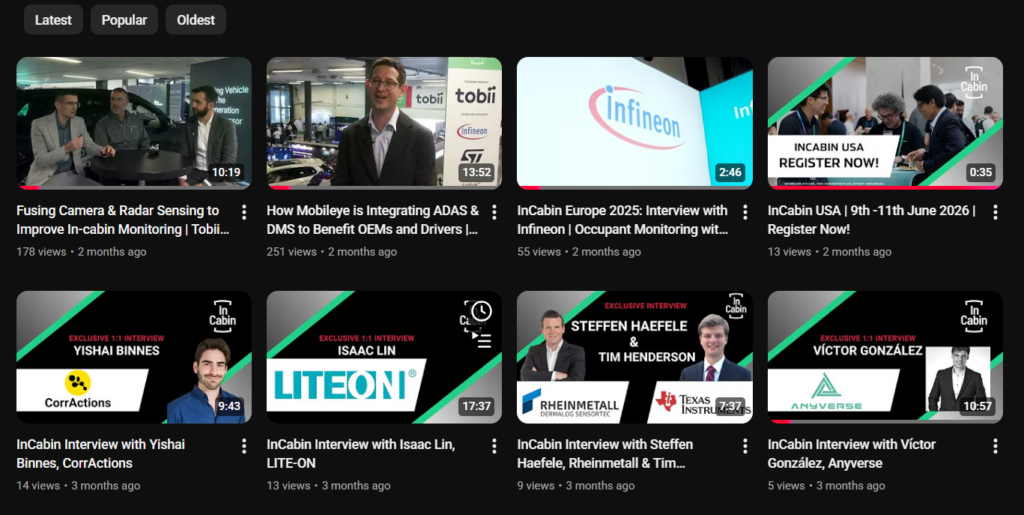
Take a look below at some of the top sessions with experts from tobii, Magna, IIHS, Alps Alpine & more!
As we move from L2 to L3, the next challenge is expanding beyond driver monitoring to cover but also ensure reliable takeover readiness in real-world conditions. This requires tighter integration between interior sensing and ADAS systems, combining driver state with real-time driving context.
This integration unlocks two critical capabilities: improved robustness in edge cases, which is essential for safe and predictable takeovers, and the foundation for new in-cabin features that extend beyond traditional safety applications.
The result is a shift from passive monitoring to adaptive, system-level approach to driver understanding, designed to scale with the next generation of automated driving.
The recent Euro NCAP Occupant Monitoring Assessment protocol has triggered an industry‑wide discussion on how to help OEMs enhance restraint strategies without false or confusing warnings that impact the ride experience.
This presentation highlights Magna’s research on combining camera and radar sensing to enhance out-of-position detection, stature classification, and occupant detection. We will discuss each technology’s strengths and limitations, show how multimodal fusion addresses their gaps, and outline Magna’s fusion strategy and key findings. Finally, we will explore future research directions and show how Magna’s approach enables OEMs to develop more reliable occupant monitoring systems without adding cost or complexity.
Partially automated (Level 2) systems have design factors that can influence driver behaviour, such as shared steering control (i.e., cooperative steering). A fundamental characteristic of cooperative steering is that the lane-centering support remains on while the driver steers within the lane.
At the time this online study of 1,260 vehicle owners was conducted, Ford and Nissan systems had a cooperative design philosophy, whereas Tesla and General Motors systems did not. IIHS found that automaker design intent does not always translate into consumer understanding because most owners thought their systems were cooperative. Likewise, hands-free capability and hands-on requirements were not universally understood.
It was also found that cooperability seems to have a situation-specific influence. Cooperative steering therefore seems to be not only a relatively intuitive design philosophy, but it also may help to promote driver engagement.
This session explores the complementary roles of radar and vision-based sensing, from core detection and classification through to more advanced analysis of occupant activity and intent.
It examines how multi-modal sensor fusion can enhance reliability across varied conditions, improving performance where individual modalities fall short, such as low light, occlusion, or complex cabin dynamics.
Alongside this, the session unpacks the advantages and trade-offs of each sensing approach, including cost, compute, and integration complexity, as well as the practical challenges of deploying fused systems at scale.
Drawing on real-world implementations, it demonstrates how these technologies perform in practice, offering insight into the current state of in-cabin perception and what is required to move toward more consistent, system-level intelligence
As the industry transitions from L2 driver-assistance toward SAE Level 3 conditional automation, the question of takeover readiness becomes central to both safety and trust.
Determining whether a driver is truly prepared to resume control requires more than monitoring eyes on road or hands on wheel; it demands a deeper understanding of human intent, cognitive load, and situational awareness in complex, real-world conditions, and equally careful design of how takeover requests are conveyed through visual, audio, and haptic cues.
This panel explores what takeover readiness really means in the shift to L3, and why interpreting human behaviour remains one of the most challenging problems engineers face in automated driving.
How can nuanced human states be sensed, fused, and translated into reliable system inputs? What signals meaningfully indicate willingness and capability to re-engage, and how should systems respond when confidence is uncertain?
Bringing together experts across in-cabin sensing, human factors, HMI, and validation, this session examines how safe, intelligible transitions of control between system and driver can be designed, communicated, and assured at scale.